
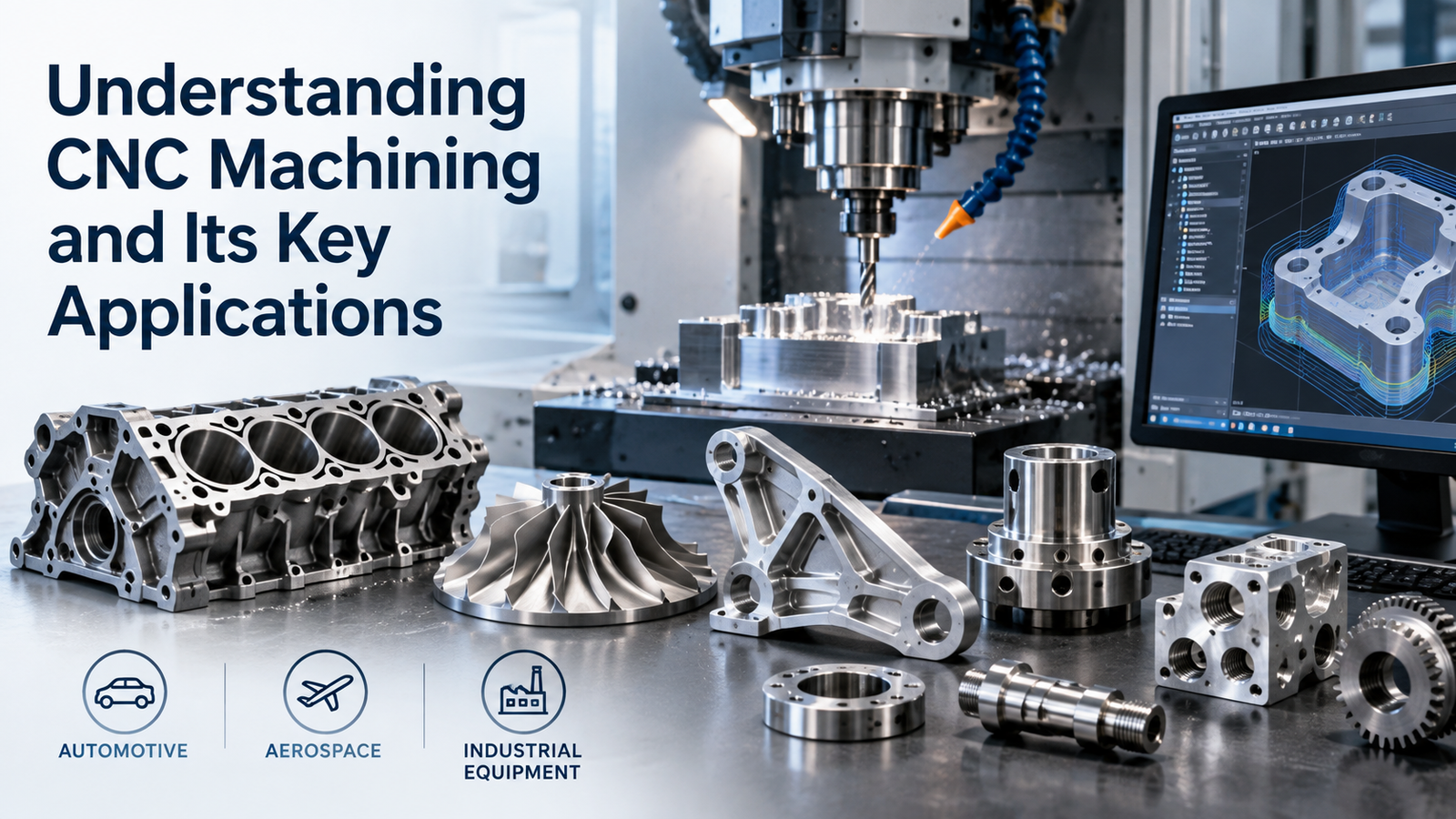
CNC machining is one of the most widely used manufacturing methods for producing accurate metal and plastic parts.
CNC stands for Computer Numerical Control. In a CNC machine, computer instructions control the movement of cutting tools and machine axes so material can be removed from a workpiece in a controlled and repeatable way.
Common CNC processes include:
- Milling
- Turning
- Drilling
- Boring
- Threading
- Reaming
CNC machining is used in industries ranging from automotive and aerospace to medical equipment, electronics, industrial machinery, molds, fixtures, and general engineering.
The importance of CNC machining comes from its ability to combine:
- Precision
- Repeatability
- Flexibility
- Automation
- Complex geometry
- Production scalability
NIST describes machining as a critical manufacturing capability and continues to research machine-tool measurement, process monitoring, accuracy, and intelligent manufacturing.
This guide explains how CNC machining works, the main machine types, core components, materials, tooling, tolerances, and major industrial applications.
Key Applications
1. What Is CNC Machining?
CNC machining is a subtractive manufacturing process.
The process begins with a block, bar, casting, forging, or other form of raw material.
A cutting tool removes unwanted material until the required geometry is produced.
The CNC controller coordinates machine movement based on a programmed toolpath.
Depending on the machine, controlled movement may include:
- X-axis
- Y-axis
- Z-axis
- Rotary axes
NIST notes that CNC reduced an important source of manual variation by coordinating machine motions automatically, although machine geometry, thermal effects, and process conditions can still influence final accuracy.
2. How CNC Machining Works
A typical CNC workflow includes:
- Design the component in CAD.
- Define machining operations in CAM.
- Generate CNC code.
- Prepare tools and workholding.
- Set work and tool offsets.
- Run or simulate the program.
- Machine the part.
- Inspect critical dimensions.
The exact process depends on:
- Machine type
- Part complexity
- Material
- Quantity
- Accuracy requirements
Modern CNC systems can also use probes, sensors, and digital manufacturing systems to support process verification and measurement.
3. What Is CNC Milling?
CNC milling uses a rotating cutting tool while the workpiece is held in a fixture.
Typical milling operations include:
- Face milling
- Pocket milling
- Slotting
- Contouring
- Drilling
- Thread milling
A basic CNC mill may control three linear axes:
- X
- Y
- Z
More advanced machining centers may add rotary axes for 4-axis or 5-axis machining.
4. What Is CNC Turning?
CNC turning normally rotates the workpiece while a cutting tool removes material.
It is commonly used for round components such as:
- Shafts
- Bushings
- Pins
- Rollers
- Sleeves
Typical turning operations include:
- Facing
- External turning
- Internal boring
- Grooving
- Threading
Modern turning centers may also include driven tools and additional axes, allowing milling operations to be completed on the same machine.
5. Milling vs Turning
| Feature | CNC Milling | CNC Turning |
|---|---|---|
| Main motion | Tool rotates | Workpiece rotates |
| Common geometry | Prismatic parts | Round parts |
| Typical products | Plates, housings, brackets | Shafts, bushings, pins |
| Common operations | Pockets, slots, contours | Facing, OD/ID turning, grooves |
| Workholding | Vise or fixture | Chuck or collet |
Some components require both milling and turning.
Multi-tasking machines can combine these operations to reduce setups.
6. Main Components of a CNC Machine
A CNC machine typically includes several major systems.
CNC Controller
The controller interprets programmed commands and coordinates machine movement.
Spindle
The spindle provides rotational motion.
In milling, it normally rotates the cutting tool.
In turning, the main spindle rotates the workpiece.
Machine Axes
Machine axes position the tool relative to the workpiece.
Tooling System
This includes:
- Toolholders
- Inserts
- End mills
- Drills
- Other cutting tools
Workholding
Workholding keeps the part secure during cutting.
Examples include:
- Vises
- Chucks
- Collets
- Fixtures
Coolant System
Coolant can help control:
- Heat
- Lubrication
- Chip evacuation
Tool Changer
Machining centers may automatically change tools during the cycle.
These systems work together to provide repeatable machining.
7. What Is CNC Programming?
CNC machines follow programmed instructions.
Traditional CNC programs commonly use G-code and related commands to control:
- Machine movement
- Feed
- Spindle speed
- Tool changes
- Coolant
Modern production often begins in CAM software.
The programmer defines:
- Cutting tools
- Operations
- Toolpaths
- Cutting parameters
A postprocessor then converts this information into code for the specific CNC control.
8. CAD and CAM in CNC Machining
CAD stands for Computer-Aided Design.
It defines the intended geometry of the part.
CAM stands for Computer-Aided Manufacturing.
CAM software helps convert the design into machining operations.
A typical digital workflow is:
- CAD
- CAM
- CNC Machine
- Inspection
NIST has researched ways to improve the flow of product and process information between design, process planning, machine tools, and inspection.
Better digital connectivity can reduce repeated manual data entry.
9. What Is Workholding?
Workholding is the system used to locate and clamp the workpiece.
Good workholding must provide:
- Rigidity
- Repeatability
- Tool access
Examples include:
- Vise
- Chuck
- Collet
- Soft jaws
- Modular fixture
- Vacuum fixture
Weak workholding can cause:
- Chatter
- Movement
- Dimensional errors
- Tool damage
Workholding is therefore part of both quality and productivity.
10. CNC Cutting Tools
Common CNC cutting tools include:
- End mills
- Face mills
- Drills
- Reamers
- Taps
- Boring bars
- Turning inserts
Tool selection depends on:
- Material
- Geometry
- Machine power
- Surface requirement
- Production quantity
Tool material and coating also affect achievable speed and tool life.
11. Speeds and Feeds
Two fundamental machining parameters are speed and feed.
Cutting Speed
Cutting speed describes the relative speed between the cutting edge and workpiece.
Feed
Feed defines how quickly the cutting edge advances through the material.
Correct values depend on:
- Tool
- Material
- Depth of cut
- Machine condition
Poor cutting parameters can create:
- Chatter
- Excessive tool wear
- Poor surface finish
- Tool breakage
12. What Is Depth of Cut?
Depth of cut defines how much material the tool removes in one pass.
A larger depth can improve material removal rate, but it also increases cutting force.
The correct depth depends on:
- Tool rigidity
- Machine power
- Workholding
- Material
Machining performance depends on balancing speed, feed, engagement, and machine stability.
13. Common CNC Materials
CNC machining can process many engineering materials.
Common metals include:
- Aluminum
- Carbon steel
- Stainless steel
- Brass
- Copper
- Tool steel
- Titanium
Common engineering plastics include:
- Acetal
- Nylon
- PEEK
- Polycarbonate
Material properties affect:
- Tool selection
- Cutting speed
- Tool wear
- Surface finish
Machinability is therefore an important design consideration.
14. CNC Machining Accuracy
CNC machines can produce highly accurate components, but accuracy depends on more than machine resolution.
Important factors include:
- Machine geometry
- Tool deflection
- Thermal effects
- Workholding
- Tool wear
- Measurement
NIST research continues to examine machine-tool thermal deformation and process measurement because these effects can influence high-accuracy machining.
15. Tolerances in CNC Machining
Tolerance defines acceptable variation from a nominal dimension.
Examples include:
- Diameter
- Length
- Hole position
- Flatness
- Runout
Tighter tolerances may require:
- Better machines
- More careful setup
- Additional finishing
- More inspection
Precision should therefore be applied where function actually requires it.
16. Surface Finish
Surface finish describes the texture of the machined surface.
It can affect:
- Friction
- Wear
- Sealing
- Appearance
Surface quality depends on factors such as:
- Tool condition
- Feed
- Speed
- Tool geometry
- Machine vibration
A roughing operation prioritizes material removal.
A finishing operation prioritizes accuracy and surface quality.
17. What Is a Machining Center?
A machining center is a CNC machine designed to perform multiple machining operations with automatic tool changing.
Common types include:
- Vertical Machining Center
- Horizontal Machining Center
A machining center can perform several operations without moving the part to another machine.
This can improve:
- Accuracy
- Productivity
- Repeatability
18. What Is 5-Axis CNC Machining?
Five-axis machines add rotary movement to the standard linear axes.
This allows the cutting tool to approach the part from multiple directions.
Advantages can include:
- Fewer setups
- Better access to complex features
- Improved accuracy between surfaces
Five-axis machining is commonly used for:
- Aerospace components
- Impellers
- Medical parts
- Complex molds
19. CNC Machining in Automotive Manufacturing
Automotive applications include:
- Engine components
- Transmission parts
- Fixtures
- Prototype components
- EV components
CNC machining is useful for both:
- Development
- Production
It is especially valuable where accurate fits and repeatable geometry are required.
20. CNC Machining in Aerospace
Aerospace components often require:
- Complex geometry
- Lightweight materials
- Tight tolerances
- High-quality surfaces
CNC machining is commonly used for:
- Structural components
- Housings
- Brackets
- Engine-related parts
Multi-axis machining is particularly useful for complex aerospace geometry.
21. CNC Machining in Medical Manufacturing
Medical manufacturing uses CNC machining for components requiring high precision.
Applications may include:
- Surgical instruments
- Device components
- Test fixtures
- Prototype parts
Material and quality requirements vary by medical application, so machining is normally combined with appropriate validation and inspection controls.
22. CNC Machining for Industrial Machinery
Industrial equipment contains many CNC-machined parts.
Examples include:
- Shafts
- Bearing housings
- Mounting plates
- Couplings
- Fixtures
Machining is particularly useful where accurate interfaces are required between mechanical components.
23. CNC Machining for Molds and Dies
CNC machining is widely used for:
- Injection molds
- Die components
- Forming tools
These applications may require:
- Complex surfaces
- Fine finishing
- Hardened materials
High-speed machining can be especially useful for mold and die work when machine dynamics, tooling, and process conditions are properly managed.
24. CNC Machining for Prototypes
CNC machining is useful for functional prototypes because it can produce parts directly from engineering materials.
NIST research has demonstrated high-speed CNC machining for functional metallic prototype production and highlighted the importance of spindle capability, tool wear, intelligent path generation, and pre-process verification.
This makes CNC machining valuable when a prototype must closely represent the final production material.
25. CNC Machining for Low-Volume Production
CNC machining is often well suited to low- and medium-volume production.
Compared with dedicated tooling processes, CNC machining can offer:
- Lower initial tooling requirements
- Faster design changes
- Flexible production
This is useful for:
- Specialized machinery
- Replacement parts
- Custom equipment
26. CNC Machining for Fixtures and Jigs
Manufacturing operations depend on fixtures and jigs to locate and support components.
CNC machining can produce:
- Precision fixture plates
- Soft jaws
- Locators
- Inspection fixtures
Because fixtures affect downstream production accuracy, CNC machining is commonly used to create controlled reference surfaces and hole patterns.
27. CNC Machining and Inspection
Inspection verifies whether the finished part meets design requirements.
Common equipment includes:
- Calipers
- Micrometers
- Height gauges
- CMMs
Modern machine tools may also perform on-machine measurements.
NIST has documented on-machine measurement use cases and the information needed to connect machining and dimensional metrology within a digital manufacturing environment.
28. Advantages of CNC Machining
Major advantages include:
- High repeatability
- Good accuracy
- Complex geometry
- Material flexibility
- Fast design changes
- Scalable production
CNC machining is especially useful when precision is important but the volume does not justify highly specialized production tooling.
29. Limitations of CNC Machining
CNC machining also has limitations.
These may include:
- Material waste from cutting
- Tool access restrictions
- Internal-corner radii
- Setup requirements
- Tool wear
Very complex internal geometry may be better suited to other processes such as additive manufacturing.
Good design should match the component geometry to the strengths of the selected manufacturing process.
CNC Machining Fundamentals at a Glance
| Topic | Purpose |
|---|---|
| CNC controller | Controls machine movements |
| Milling | Machines prismatic geometry |
| Turning | Machines rotational geometry |
| CAD | Defines product geometry |
| CAM | Creates machining strategy |
| Workholding | Secures and locates workpiece |
| Cutting tools | Remove material |
| Speeds and feeds | Control cutting conditions |
| Tolerances | Define acceptable variation |
| Inspection | Confirms finished quality |
| Multi-axis machining | Produces complex geometry |
| Automation | Improves repeatability and productivity |
Common Beginner Mistakes
New CNC users should avoid:
- Incorrect work offsets
- Excessive tool overhang
- Poor workholding
- Wrong cutting parameters
- Using worn tools
- Skipping simulation or prove-out
- Ignoring chip evacuation
- Applying tight tolerances unnecessarily
- Failing to inspect critical dimensions
A stable CNC process depends on both the program and the physical machining setup.
Why CNC Machining Remains Important
Advanced manufacturing increasingly includes:
- Additive manufacturing
- Robotics
- AI
- Digital twins
However, CNC machining remains essential because many components still require:
- Accurate surfaces
- Bearing fits
- Precision holes
- Threads
- Final dimensional control
Even additive-manufactured components are frequently CNC machined afterward to create functional interfaces.
CNC machining therefore remains a core manufacturing technology while continuing to become more connected and intelligent.
Conclusion
CNC machining is a computer-controlled subtractive manufacturing process used to create accurate and repeatable engineering components.
Its key technologies include:
- CNC milling
- CNC turning
- CAD/CAM programming
- Cutting tools
- Workholding
- Tolerance control
- Inspection
CNC machining is used across automotive, aerospace, medical, industrial machinery, mold and die, prototyping, low-volume production, and fixture manufacturing.
NIST research also shows how modern machining continues to evolve through process monitoring, on-machine measurement, digital information exchange, and intelligent machine-tool technologies. citeturn692556search2turn692556search6
The fundamental principle remains simple:
A CNC machine follows controlled toolpaths to remove material, but successful machining depends on much more than the program alone.
Tooling, workholding, machine condition, process parameters, tolerances, and inspection all work together to produce a reliable finished part.