
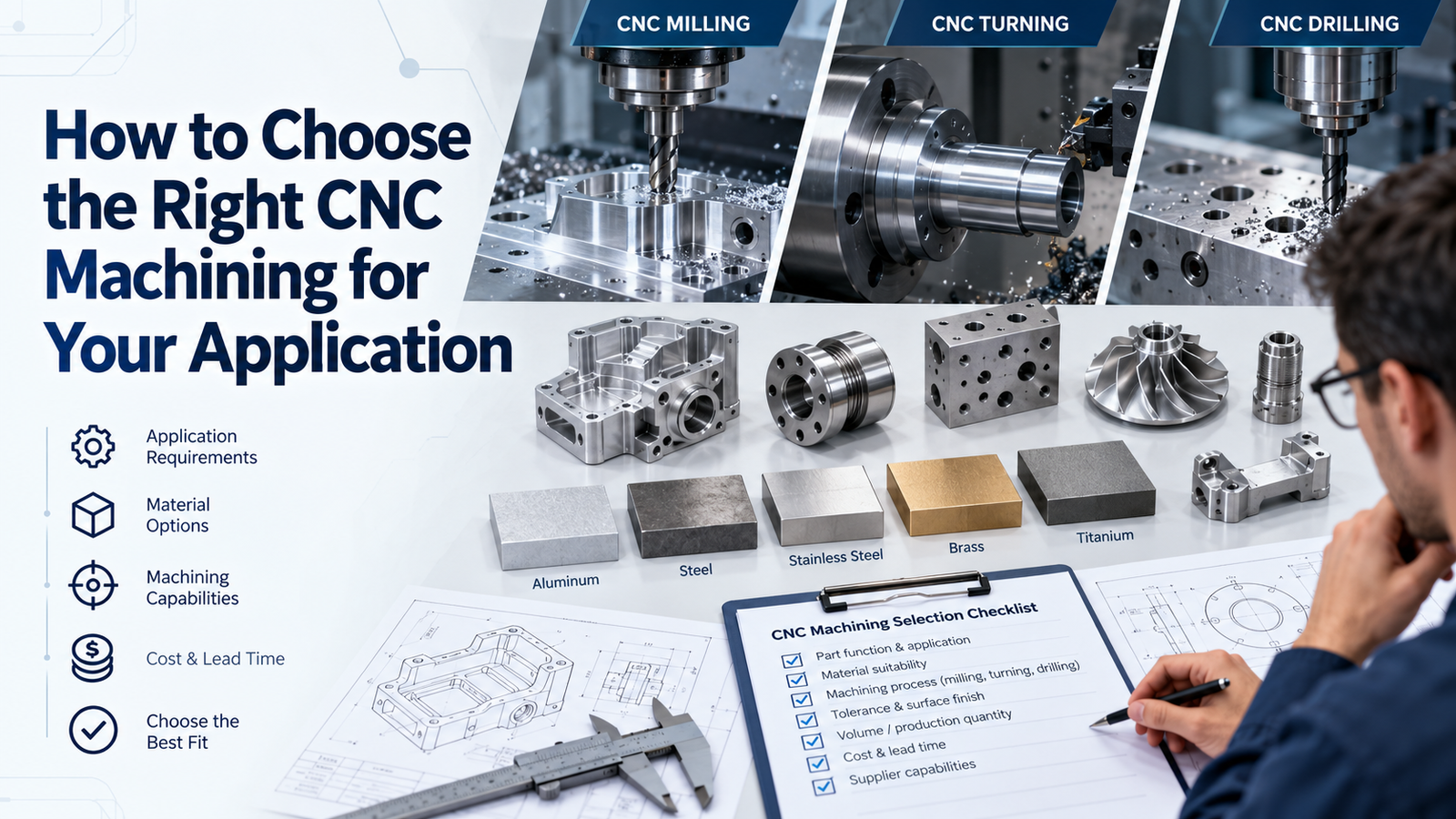
Choosing the right CNC machining process is not simply a matter of finding a supplier with a CNC machine.
The correct choice depends on the relationship between:
- Part geometry
- Material
- Tolerance
- Surface finish
- Quantity
- Machine size
- Tool access
- Setup count
- Inspection requirements
- Total cost
A round shaft, a complex aerospace bracket, a large fixture plate, and a precision bearing housing may all require CNC machining, but they should not necessarily be produced using the same machine type or production strategy.
This CNC machining selection guide explains how to compare milling, turning, multi-axis machining, precision machining, and supplier capability for different engineering applications.
Implementation Steps and Best Practices
1. Start With the Part Geometry
Geometry is usually the first selection factor.
Ask whether the part is primarily:
- Rotational
- Prismatic
- Freeform
- Multi-sided
Rotational parts often favor CNC turning.
Prismatic parts usually favor CNC milling.
Complex components with features on many faces may justify 3+2-axis or 5-axis machining.
Do not select the machine before understanding how the cutting tool must reach the required features.
2. Choose CNC Turning for Rotational Parts
CNC turning is usually well suited to components whose main geometry is based around a central axis.
Examples include:
- Shafts
- Pins
- Bushings
- Rollers
- Sleeves
- Spacers
The workpiece rotates while the cutting tool removes material.
Turning is especially efficient for features such as:
- Outside diameters
- Bores
- Grooves
- Threads
- Faces
For a mostly cylindrical component, turning can be more efficient than milling the same geometry from solid stock.
3. Choose CNC Milling for Prismatic Parts
CNC milling is generally suited to parts with:
- Flat faces
- Pockets
- Slots
- Hole patterns
- Contours
Typical products include:
- Brackets
- Housings
- Plates
- Fixtures
- Machine components
The cutting tool rotates while the workpiece remains clamped.
Three-axis milling is often adequate when the required geometry can be accessed mainly from one or a few straightforward orientations.
4. Consider Mill-Turn or Multi-Tasking for Mixed Geometry
Some parts combine rotational and prismatic features.
For example, a shaft may also require:
- Flats
- Cross holes
- Key features
These parts may otherwise need both a lathe and a milling machine.
A mill-turn or multi-tasking machine can sometimes complete both operations in fewer setups.
Benefits may include:
- Better feature-to-feature accuracy
- Less handling
- Reduced setup time
The economic benefit depends on part complexity and quantity.
5. Decide Whether 3-Axis Machining Is Enough
Three-axis machining controls X, Y, and Z movement.
It is appropriate for many common parts.
Examples include:
- Plates
- Simple housings
- Fixture components
- Pockets
Three-axis machining is often easier to program and may have a lower machine rate than more complex equipment.
Choose it when the geometry does not require additional rotational positioning.
6. Use 3+2 Machining for Multiple Faces
In 3+2 machining, the machine indexes the part into an orientation and then performs conventional three-axis cutting.
It can be useful when features exist on:
- Top
- Sides
- Angled faces
but do not require simultaneous five-axis motion.
This can reduce manual re-clamping compared with multiple conventional setups.
7. Choose 5-Axis Machining for Complex Access
Five-axis machining can move linear and rotary axes in a coordinated way.
It is useful for:
- Impellers
- Complex aerospace components
- Medical parts
- Mold surfaces
- Multi-sided precision parts
Protolabs' current machining guidelines distinguish separate 3-axis and 5-axis capability ranges, reinforcing that geometry, size, and material affect which machine class is appropriate. citeturn718386search0turn718386search1
Five-axis machining may reduce the number of setups, but it usually requires:
- More capable machines
- Advanced CAM
- More experienced programming
Use it where the complexity justifies the process.
8. Check Part Size Against Machine Capacity
Every CNC machine has physical limits.
Important parameters include:
- X travel
- Y travel
- Z travel
- Table size
- Chuck capacity
- Maximum workpiece diameter
- Maximum workpiece length
Protolabs publishes different maximum part dimensions for its 3-axis, 5-axis, and turning services, illustrating why supplier machine envelope must be checked early. citeturn718386search0turn718386search2
Do not assume that a supplier advertising 5-axis machining can handle every 5-axis part size.
9. Consider Material Machinability
Material influences the process.
Common CNC materials include:
- Aluminum
- Carbon steel
- Stainless steel
- Brass
- Copper
- Titanium
- Engineering plastics
Material affects:
- Cutting speed
- Tool life
- Machine power
- Coolant requirements
Hard or difficult materials may require more rigid machines and specialized tools.
Supplier experience with the actual material can be as important as the machine specification.
10. Match the Machine to the Tolerance
Tolerance requirements can change the correct process choice.
A general machining process may be sufficient for ordinary dimensions.
Precision features may require:
- Better machine capability
- Stable fixturing
- Additional finishing
- Advanced inspection
Current Protolabs guidance separates general CNC machining capability from precision machining services with tighter standard tolerances, showing why tolerance should be part of process selection rather than an afterthought. citeturn718386search1
11. Do Not Specify Tight Tolerances Everywhere
Tight tolerances increase manufacturing difficulty.
Apply them where needed for:
- Fits
- Alignment
- Sealing
- Precision motion
Noncritical dimensions should use appropriate general tolerances.
Xometry's manufacturing standards also distinguish normal CNC dimensional tolerances from custom geometric and tighter requirements. citeturn718386search3
This helps keep the part manufacturable and cost-effective.
12. Consider Surface Finish
Surface finish requirements influence both process and tooling.
Ask whether the part needs:
- Standard machined finish
- Fine finishing
- Grinding
- Polishing
- Coating
A high-quality cosmetic or functional surface may require additional finishing passes or secondary processes.
Do not choose the machining process based only on dimensional tolerance.
13. Evaluate Internal Features
Internal geometry often determines tool accessibility.
Examples include:
- Deep pockets
- Narrow slots
- Small holes
- Undercuts
Deep pockets may require long tools, which reduce rigidity.
Undercuts may require special cutters or additional setups.
A part that looks simple externally may be difficult to machine because of internal access.
14. Avoid Unrealistic Internal Corners
Rotating milling cutters naturally create internal radii.
Sharp internal corners may require:
- Very small tools
- Special processes
- EDM
Where possible, use reasonable corner radii.
This improves tool access and reduces cycle time.
15. Check Hole Requirements
Hole-making requirements can influence the process.
Consider:
- Diameter
- Depth
- Thread
- Tolerance
- Orientation
A simple drilled clearance hole is different from a precision reamed bore.
Multiple angled holes may justify multi-axis capability.
16. Consider Wall Thickness
Very thin walls can deflect during cutting.
This may require:
- Reduced cutting force
- Extra finishing
- Special fixturing
For thin components, process stability may be more important than maximum material removal rate.
Choose a supplier experienced in thin-wall machining.
17. Consider the Number of Setups
Every setup creates:
- Labor
- Alignment risk
- Handling time
A part that requires six setups on a 3-axis mill might be more efficiently produced in fewer setups on a 5-axis machine.
However, the 5-axis machine may have a higher hourly rate.
Compare:
Total process cost, not only machine hourly rate.
18. Choose the Correct Workholding Strategy
Workholding must provide:
- Rigidity
- Repeatability
- Tool access
Options include:
- Vises
- Chucks
- Collets
- Soft jaws
- Dedicated fixtures
- Zero-point systems
For repeat production, a dedicated fixture may reduce cycle and setup time enough to justify its initial cost.
19. Match the Process to Production Volume
Quantity affects the best machining strategy.
Prototype
Priorities may include:
- Fast setup
- Flexible tooling
Low Volume
Reusable fixtures may start becoming worthwhile.
Higher Volume
Consider:
- Dedicated fixtures
- Bar feeders
- Pallet systems
- Robotics
The cheapest prototype process may not be the cheapest production process.
20. Consider Automation for Repetitive Production
For recurring parts, automation can improve:
- Machine utilization
- Labor efficiency
- Repeatability
Possible automation includes:
- Robot loading
- Bar feeding
- Pallet changing
- In-process probing
Ask the supplier whether the part is suited to an automated cell.
21. Check Inspection Capability
The supplier must be able to verify the tolerance it promises.
Inspection equipment may include:
- Micrometers
- Height gauges
- CMMs
- Surface roughness testers
If the drawing contains complex GD&T, confirm that the supplier has suitable metrology capability.
22. Consider Quality Documentation
Some applications require:
- Material certificates
- Inspection reports
- First Article Inspection
- Traceability
Include these requirements before requesting quotes.
Documentation can affect both supplier selection and cost.
23. Review Supplier Experience
A capable CNC shop is not automatically capable of every CNC part.
Ask about experience with:
- Your material
- Your tolerance class
- Your geometry
- Similar industries
A supplier already familiar with the application may reduce development risk.
24. Consider Machine Capability, Not Just Machine Type
Two suppliers may both advertise 5-axis machining but have very different:
- Machine sizes
- Spindle speeds
- Accuracy
- Workholding
Likewise, turning centers can differ in:
- Chuck capacity
- Bar capacity
- Live tooling
Request actual machine capability for demanding parts.
25. Compare Lead Time
Lead time may depend on:
- Material availability
- Machine scheduling
- Inspection
- Finishing
A technically ideal supplier may not fit a time-critical project if its capacity is fully booked.
Commercial selection should balance:
- Capability
- Quality
- Delivery
- Cost
26. Compare Total Cost, Not Only Part Price
A low quote can become expensive if it creates:
- Rework
- Quality problems
- Late delivery
Consider total procurement cost including:
- Tooling
- Inspection
- Shipping
- Rejection risk
- Lead time
The best supplier is the one that reliably meets the application requirements at an acceptable total cost.
CNC Machining Selection Matrix
| Application | Likely CNC Process |
|---|---|
| Round shaft | CNC turning |
| Plate with pockets | 3-axis milling |
| Multi-sided housing | 3+2 or 5-axis milling |
| Complex impeller | 5-axis milling |
| Shaft with milled flats | Mill-turn |
| Precision bore housing | Precision milling/boring |
| High-volume round part | CNC turning + bar feed |
| Multi-face low-volume part | 5-axis machining |
This is a starting point rather than a universal rule.
CNC Supplier Selection Checklist
Before placing an order, confirm:
- Machine process
- Maximum part size
- Supported material
- Tolerance capability
- Surface-finish capability
- Inspection equipment
- Production capacity
- Lead time
- Quality documentation
- Automation capability
Common Selection Mistakes
Avoid these mistakes:
- Using 5-axis when 3-axis is sufficient
- Milling a part better suited to turning
- Ignoring machine envelope
- Specifying unnecessary tight tolerances
- Choosing solely by hourly rate
- Ignoring tool access
- Ignoring inspection capability
- Selecting a supplier without checking material experience
- Failing to consider production volume
- Comparing quotes with different quality assumptions
The right CNC process balances technical requirements with manufacturability and commercial efficiency.
Conclusion
A good CNC machining selection guide starts with the part rather than the machine.
Evaluate:
- Part geometry.
- Rotational vs prismatic features.
- Number of accessible faces.
- Material.
- Size.
- Tolerance.
- Surface finish.
- Quantity.
- Inspection.
- Total cost.
CNC turning is usually well suited to rotational components, while CNC milling is preferred for prismatic parts. Three-axis machining is efficient for simpler geometry, while 3+2 and 5-axis machining become valuable as feature access and setup complexity increase.
Current supplier design guidance also shows why machine envelope, material, feature geometry, and tolerance capability must be checked before selecting a manufacturing route. citeturn718386search0turn718386search1turn718386search2
The best choice is not the most advanced machine.
It is the process that produces the required geometry, tolerance, finish, and volume reliably at the lowest practical total cost.