
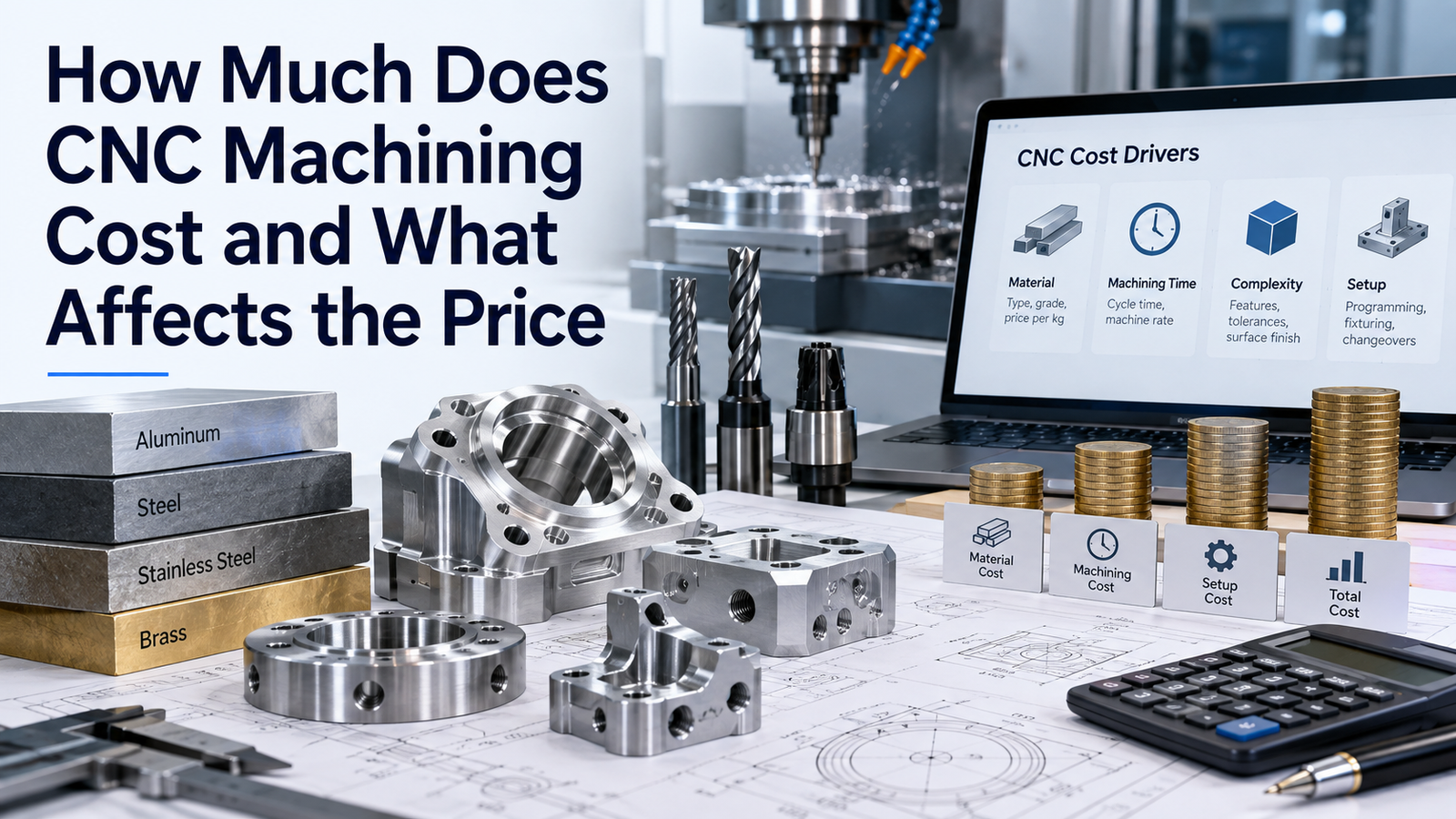
CNC machining cost can vary significantly from one part to another.
A simple aluminum bracket may be relatively straightforward to machine, while a complex stainless steel component with deep pockets, tight tolerances, multiple setups, inspection requirements, and finishing operations can cost much more.
There is no single universal price for CNC machining.
The final quotation usually depends on a combination of:
- Material
- Machine time
- Part geometry
- Setup requirements
- Tolerances
- Quantity
- Tooling
- Inspection
- Surface finishing
- Lead time
- Supplier capability
Understanding these factors helps engineers and procurement teams compare quotations more effectively and redesign parts to reduce unnecessary cost.
This guide explains the main factors that affect CNC machining cost and how buyers can make more cost-effective sourcing decisions.
Key Cost Factors
1. Material Cost
Material is one of the first cost drivers in CNC machining.
Common CNC materials include:
- Aluminum
- Carbon steel
- Stainless steel
- Brass
- Copper
- Titanium
- Engineering plastics
Material cost depends on:
- Raw material price
- Availability
- Stock size
- Waste
- Machinability
Xometry notes that harder or less machinable materials may require specialized tooling and longer machining time in addition to having higher raw-material cost.
This means material choice affects both the purchase price of the stock and the time required to machine it.
2. Machinability Affects Price
Two materials of similar raw-material price may have very different machining costs.
Easy-to-machine materials may allow:
- Higher cutting speeds
- Longer tool life
- Faster cycle times
Difficult materials may require:
- Lower cutting speeds
- More expensive tooling
- More frequent tool changes
- More coolant control
For example, hard stainless steels or titanium alloys usually require more careful machining than many common aluminum alloys.
The best material therefore depends on both functional requirements and manufacturing economics.
3. Machine Time Is a Major Cost Driver
CNC suppliers often calculate a significant portion of cost from machine time.
Machine time includes:
- Roughing
- Finishing
- Drilling
- Threading
- Boring
- Tool changes
- Positioning
A part requiring 60 minutes of machine time will normally cost more than a similar part requiring 10 minutes.
This is why geometry that increases cycle time directly affects the quotation.
4. Part Complexity Increases Cost
Complex geometry may require:
- More toolpaths
- Smaller cutters
- Additional setups
- More programming
- Longer inspection
Examples of cost-increasing features include:
- Deep pockets
- Narrow slots
- Thin walls
- Complex contours
- Undercuts
- Multiple orientations
Protolabs' CNC design guidance emphasizes designing features that can be reached efficiently by standard cutting tools.
Simplifying geometry can reduce both machining and programming time.
5. Deep Pockets Can Be Expensive
Deep pockets often require long cutting tools.
Long tools are less rigid and may need:
- Slower feeds
- Lighter cuts
- Multiple passes
This increases cycle time.
Deep narrow pockets can also create:
- Chip evacuation problems
- Chatter
- Tool breakage risk
If the design allows, shallower pockets or larger corner radii can reduce cost.
6. Sharp Internal Corners Increase Cost
CNC milling tools are round.
This means an internal corner naturally has a radius.
A perfectly sharp internal corner may require:
- Very small cutters
- EDM
- Additional manufacturing operations
Protolabs notes that very small end mills used to achieve sharp internal corners can be slow and delicate, increasing machining cost.
A larger internal radius is generally easier and faster to machine.
7. Tight Tolerances Increase CNC Machining Cost
Tolerances have a major impact on cost.
Tighter tolerances may require:
- Slower machining
- Additional finishing passes
- More rigid setups
- Better tooling
- More inspection
Xometry notes that tighter tolerances can increase cost because of additional fixturing, measurement requirements, longer cycle time, and higher scrap risk.
Protolabs similarly advises applying tight tolerances only to features that truly require them.
8. Use Standard Tolerances Where Possible
Not every dimension needs precision.
Examples of features that may not require tight tolerances include:
- Cosmetic surfaces
- Clearance features
- Nonfunctional outer dimensions
Critical features such as:
- Bearing bores
- Sealing surfaces
- Precision fits
- Datum features
may require tighter control.
Applying precision only where function requires it can reduce both machining and inspection cost.
9. GD&T Can Affect Quotation Price
Geometric Dimensioning and Tolerancing can improve design communication, but complex or tight GD&T requirements may increase cost.
Possible cost drivers include:
- CMM inspection
- Additional setups
- Special fixtures
- More detailed quality reports
GD&T should be used to control function, not to make every feature highly precise.
10. Quantity Strongly Affects Unit Cost
Small batches usually have higher cost per part.
This is because fixed costs must be spread across fewer pieces.
Fixed costs may include:
- Programming
- Setup
- Fixture preparation
- First-part inspection
Xometry notes that larger production volumes generally reduce unit cost because setup costs are distributed across more parts.
For example, the first part may include substantial setup effort, while subsequent parts mainly consume machine time and material.
11. Setup Time Matters
A part requiring one setup is usually cheaper than a part requiring several setups.
Each setup may require:
- Re-clamping
- Re-establishing work coordinates
- Fixture changes
- Additional inspection
Multiple setups also create more opportunity for dimensional variation.
Designing parts that can be machined from fewer orientations can reduce cost.
12. 3-Axis vs 5-Axis Machining
Machine type can influence price.
Three-axis machining may be cost-effective for simpler components.
Five-axis machining can reduce setups for complex geometry but may involve:
- More expensive machines
- More advanced programming
- Higher hourly rates
However, five-axis machining is not automatically more expensive overall.
If it eliminates several manual setups, it may reduce total cost for complex parts.
The correct comparison is total process cost, not only machine hourly rate.
13. Tooling Cost
Cutting tools are consumable.
Tooling cost may include:
- End mills
- Drills
- Inserts
- Reamers
- Special cutters
Xometry identifies machine tooling and tool replacement as part of total CNC cost.
Materials that wear tools quickly can increase tooling expense.
Special custom tooling can also increase quotation price.
14. Tool Changes Add Cycle Time
Each tool change consumes time.
A part requiring many different tools may have a longer cycle.
Possible tools include:
- Roughing end mill
- Finishing end mill
- Drill
- Reamer
- Tap
- Chamfer tool
Designing around standard tools and minimizing unnecessary operations may reduce machine time.
15. Hole Requirements Affect Cost
Simple drilled holes are usually economical.
Cost increases when holes require:
- Tight diameter tolerance
- Reaming
- Deep drilling
- Special threading
- Precision position
Protolabs publishes separate tolerance capabilities for standard holes and tighter bore-style features, illustrating how higher precision often requires different manufacturing or inspection effort.
16. Threading Adds Cost
Threads may be produced by:
- Tapping
- Thread milling
- Single-point turning
Thread cost depends on:
- Size
- Depth
- Quantity
- Material
Deep threads or uncommon thread standards can increase manufacturing time.
Use standard thread sizes where possible.
17. Thin Walls Increase Risk
Thin walls can deflect during machining.
This may require:
- Lighter cutting
- Additional finishing
- Special fixturing
Deflection can create dimensional error and scrap.
Increasing wall thickness where possible can improve manufacturability.
18. Surface Finish Affects Price
A normal machined finish is usually cheaper than specialized finishing.
Additional requirements may include:
- Grinding
- Polishing
- Bead blasting
- Anodizing
- Plating
- Heat treatment
Each secondary process adds:
- Processing cost
- Handling
- Lead time
Finishing should be specified only where it is required for function or appearance.
19. Inspection Cost
Inspection becomes more expensive as requirements become more demanding.
Simple inspection may use:
- Calipers
- Micrometers
Advanced inspection may require:
- CMM
- Surface roughness measurement
- Special gauges
- Inspection reports
Tight tolerances and complex GD&T can increase inspection time.
This cost is often included in the quotation.
20. Quality Documentation Can Add Cost
Some industries require additional documentation.
Examples include:
- Material certificates
- First Article Inspection
- Inspection reports
- Traceability records
These requirements add engineering and quality-assurance time.
Include them in the RFQ so the supplier can quote accurately.
21. Scrap Risk Affects Supplier Pricing
Suppliers consider the risk of producing nonconforming parts.
Higher risk may result from:
- Tight tolerances
- Thin walls
- Difficult materials
- Complex setups
If a nearly completed part is scrapped late in the process, the supplier loses both material and machine time.
Quotation prices may therefore include risk allowance.
22. Lead Time Can Affect Cost
Urgent orders may cost more.
Expedited production can require:
- Schedule changes
- Overtime
- Faster material sourcing
- Priority inspection
If the project schedule allows flexibility, standard lead times may provide a lower quotation.
23. Supplier Capability Matters
Two suppliers may quote very different prices for the same part.
Differences may come from:
- Machine type
- Automation
- Tooling
- Fixture systems
- Material purchasing power
- Programming efficiency
- Inspection capability
A supplier that routinely machines a particular material or geometry may produce the part more efficiently.
The lowest machine hourly rate does not always produce the lowest finished-part cost.
24. Automation Can Reduce Production Cost
Automation may include:
- Bar feeders
- Pallet systems
- Robot loading
- In-process probing
- Automated tool monitoring
Automation can reduce labor and improve repeatability in suitable production volumes.
Parts designed for repeat production may benefit from suppliers with automated manufacturing capability.
25. CNC Milling vs CNC Turning Cost
The most economical process depends on geometry.
Round components may be cheaper to produce on a CNC lathe.
Prismatic components may be better suited to milling.
Some parts require both.
Designing the part around the natural strengths of the manufacturing process can reduce cost.
26. Cost Per Part Usually Falls With Volume
As volume increases, fixed costs are spread over more units.
This can reduce the effect of:
- Programming
- Setup
- Fixture preparation
However, very high production volumes may justify:
- Dedicated fixtures
- Automation
- Different manufacturing processes
Procurement teams should request quotations at realistic annual quantities rather than only prototype quantities.
27. How to Reduce CNC Machining Cost
Practical cost-reduction actions include:
- Choose machinable materials where function allows
- Avoid unnecessary tight tolerances
- Increase internal corner radii
- Avoid unnecessarily deep pockets
- Reduce setups
- Use standard holes and threads
- Avoid very thin walls
- Minimize secondary finishing
- Increase batch size where practical
- Design for standard cutting tools
These changes can reduce cost without sacrificing product function.
CNC Machining Cost Breakdown
| Cost Driver | Why It Affects Price |
|---|---|
| Material | Raw stock and machinability |
| Machine time | Longer cycles cost more |
| Geometry | Complexity increases programming and machining |
| Tolerances | Precision requires slower processing and inspection |
| Quantity | Setup cost is spread across units |
| Setups | More orientations increase labor and time |
| Tooling | Tool wear and special cutters add cost |
| Inspection | Tight requirements need advanced measurement |
| Finishing | Secondary processes add handling and lead time |
| Lead time | Expediting may require priority resources |
| Supplier capability | Efficiency varies by equipment and experience |
Questions to Ask When Comparing CNC Quotes
Do not compare only total price.
Ask suppliers:
- What material grade is quoted?
- What tolerance standard is assumed?
- Are inspection reports included?
- Is finishing included?
- What quantity is the price based on?
- What is the lead time?
- Are tooling or setup charges included?
This helps prevent hidden differences between quotations.
Common CNC Procurement Mistakes
Avoid these mistakes:
- Specifying tight tolerances everywhere
- Requesting unrealistic lead times
- Comparing quotes with different material grades
- Ignoring inspection requirements
- Selecting suppliers only by hourly rate
- Using overly complex geometry without functional need
- Ordering prototype quantities repeatedly instead of planning batches
- Omitting finishing or documentation requirements from the RFQ
- Accepting the lowest price without checking capability
A quotation should be evaluated for total value, quality, delivery, and risk.
Conclusion
There is no universal answer to how much CNC machining costs because every part has a different combination of material, geometry, tolerances, setups, machine time, quantity, inspection, and finishing requirements.
The largest CNC machining cost drivers are typically:
- Material and machinability.
- Machine cycle time.
- Part complexity.
- Number of setups.
- Tolerance requirements.
- Quantity.
- Tooling.
- Inspection.
- Surface finishing.
- Lead time and supplier capability.
Current manufacturing guidance from Xometry and Protolabs consistently shows that tighter tolerances, difficult materials, complex geometry, small quantities, and additional inspection can increase cost, while simpler features, standard tolerances, larger batches, and design-for-machining practices can reduce it.
Instead of asking only, "What is the cheapest CNC supplier?" procurement teams should ask:
How can this part be designed and sourced so that the required function is achieved with the least unnecessary machining effort?
That approach usually creates better long-term results for cost, quality, and supply reliability.