
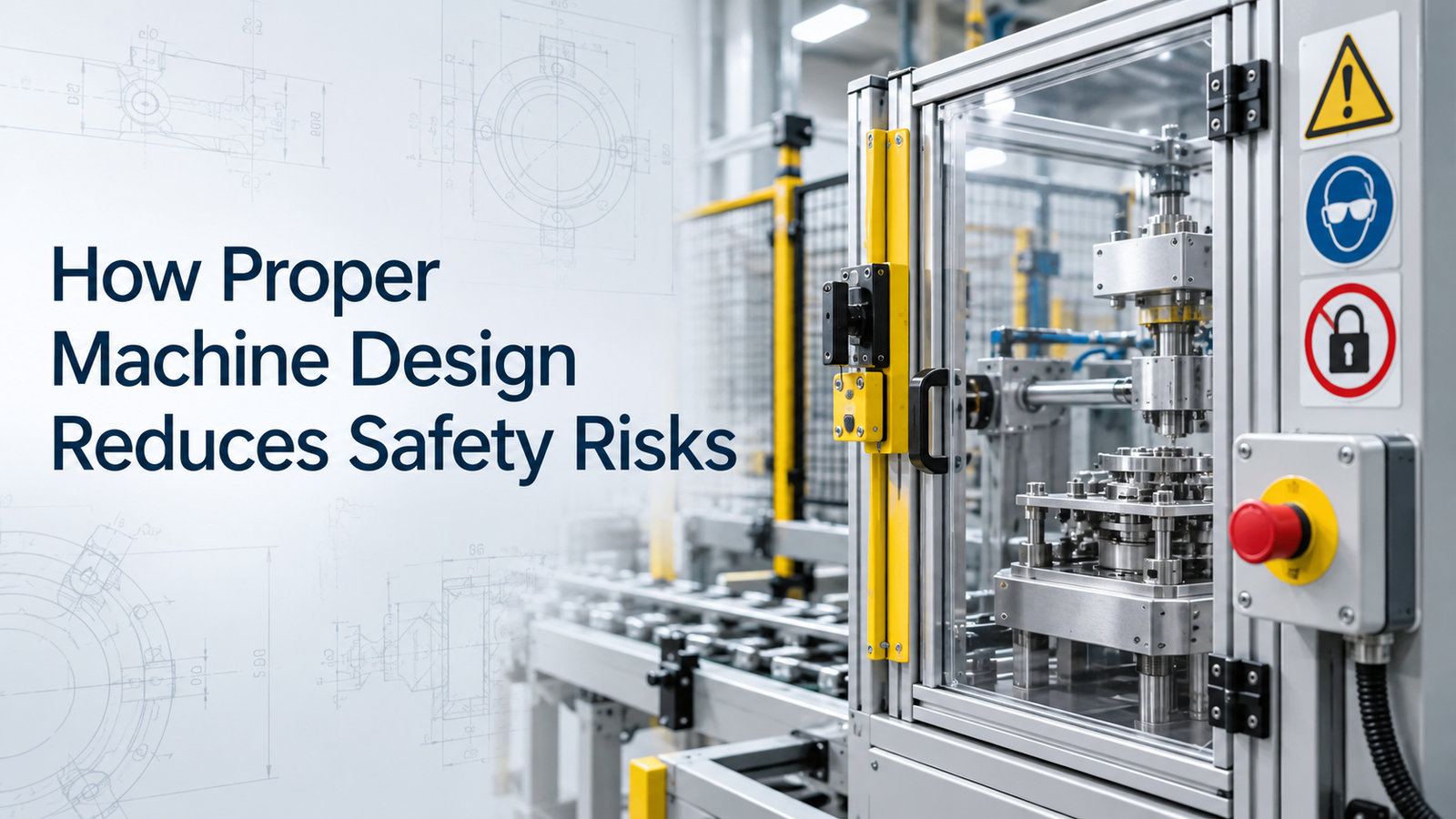
Machine safety is most effective when it begins at the design stage.
Many industrial hazards are created by the way a machine is laid out, powered, supported, guarded, accessed, and maintained. If dangerous motion, poor access, unstable structures, stored energy, or pinch points are built into the machine, safety becomes harder and more expensive to manage later.
This is why machine design fundamentals safety should focus first on eliminating or reducing hazards through engineering.
A well-designed machine can reduce operator exposure, limit dangerous motion, control stored energy, make maintenance safer, and reduce dependence on warnings or procedural controls.
This guide explains how proper machine design reduces safety risks in practical industrial applications.
Key Safety Practices and Standards
1. Start With Hazard Identification
Before detailed CAD work begins, identify the hazards associated with the machine.
Typical hazards may include:
- Crushing
- Shearing
- Cutting
- Pinching
- Entanglement
- Rotating parts
- Falling loads
- Stored energy
- Hot surfaces
- Unexpected movement
The assessment should cover the full machine lifecycle, including:
- Installation
- Production
- Setup
- Cleaning
- Maintenance
- Troubleshooting
- Tool change
- Decommissioning
ISO 12100 provides a systematic framework for machinery risk assessment and risk reduction.
The objective is to identify foreseeable hazards before the machine layout becomes difficult to change.
2. Eliminate Hazards Through Design
The most effective risk reduction often comes from removing the hazard itself.
Examples include:
- Moving a drive away from operator access
- Enclosing a rotating shaft inside the machine frame
- Eliminating exposed pinch points
- Automating a hazardous manual loading step
- Reducing exposed sharp edges
This is more effective than designing a dangerous mechanism first and relying only on guards afterward.
For example, relocating a chain drive inside an enclosed section of the frame can reduce direct exposure without requiring a large external guard.
3. Reduce the Amount of Dangerous Motion
Machine performance does not always require maximum speed, force, or travel.
Reducing unnecessary motion can reduce risk.
Examples include:
- Limiting actuator stroke
- Reducing moving mass
- Lowering unnecessary speed
- Restricting travel into operator areas
Less stored kinetic energy can make stopping easier and reduce the severity of potential contact.
Designers should match motion capability to the actual process requirement rather than maximizing it by default.
4. Remove or Control Pinch Points
Pinch points are created where moving parts approach fixed or moving surfaces.
Common examples include:
- Sliding tables
- Pneumatic cylinders
- Hinges
- Belts and pulleys
- Chains and sprockets
- Linkages
- Clamping mechanisms
Review the machine through its full movement range.
A safe-looking gap in one position may become hazardous later in the cycle.
Potential design responses include:
- Increasing clearance
- Enclosing the mechanism
- Relocating the mechanism
- Using a protective cover
- Restricting access
5. Integrate Guarding Into the Mechanical Layout
Guarding works best when it is part of the machine design rather than an afterthought.
Common guarding options include:
- Fixed guards
- Interlocked doors
- Covers
- Fencing
- Barrier systems
OSHA machine-guarding requirements address hazards such as points of operation, rotating parts, and ingoing nip points in covered U.S. workplaces.
Good guarding should also consider usability.
If operators constantly need to remove a guard to perform normal work, the overall design should be reviewed.
6. Apply Correct Safety Distances
Physical distance can prevent access to dangerous areas.
ISO 13857 provides safety-distance guidance intended to prevent upper and lower limbs from reaching hazardous zones.
This is important when designing:
- Perimeter fencing
- Guard openings
- Access gaps
- Openings around covers
Do not estimate these distances visually.
Use the applicable standard and the actual hazard geometry.
7. Control Stored Energy
A machine can remain hazardous after electrical power is removed.
Stored energy may include:
- Pneumatic pressure
- Hydraulic pressure
- Springs
- Gravity
- Tensioned mechanisms
- Flywheels
Design should provide ways to control or release this energy safely.
Possible measures include:
- Mechanical blocks
- Pressure dump valves
- Brakes
- Locking positions
- Support devices
For example, a vertically moving axis may require a mechanical support or brake so it cannot fall during maintenance.
8. Design Stable Machine Structures
Machines should remain stable during normal and abnormal conditions.
Check stability during:
- Acceleration
- Deceleration
- Loading
- Emergency stopping
- Maintenance
Important factors include:
- Center of gravity
- Base width
- Anchoring
- Dynamic forces
- External loads
A machine that can shift or tip under dynamic load presents a serious safety risk.
Structural stability should therefore be checked before finalizing the frame.
9. Consider Component Failure Modes
Ask what happens when a component fails.
Examples include:
- Belt break
- Coupling failure
- Shaft break
- Bearing seizure
- Pneumatic pressure loss
- Broken chain
A good design should prevent one failure from creating a larger uncontrolled hazard where reasonably practicable.
Possible safeguards include:
- Secondary supports
- Mechanical stops
- Retaining devices
- Brakes
- Guards
Failure-mode thinking improves both reliability and safety.
10. Use Mechanical Limits Where Needed
Software and sensors are important, but some motion should also have physical limits.
Examples include:
- End stops
- Travel stops
- Retainers
- Mechanical blocks
These can prevent excessive movement if:
- A sensor fails
- Software is incorrect
- The drive loses position
Mechanical stops should also be designed for the energy they may need to absorb.
11. Reduce Sharp Edges and Projections
Not all machine hazards involve powered motion.
Sharp edges, corners, and protruding fasteners can create:
- Cuts
- Impact injuries
- Snagging hazards
Review:
- Sheet-metal edges
- Frame corners
- Brackets
- Long bolt ends
- Cable trays
Use rounded edges, covers, suitable fastener lengths, and proper finishing.
Small design improvements can reduce common workplace injuries.
12. Make Maintenance Access Safer
Maintenance personnel often enter areas that operators do not.
Design safe access to:
- Bearings
- Motors
- Sensors
- Filters
- Lubrication points
- Belts
- Couplings
Avoid designs that require technicians to:
- Work under unsupported loads
- Reach through dangerous mechanisms
- Climb on unstable structures
- Remove major guarding unnecessarily
Maintenance safety should be considered during the original layout.
13. Design for Safe Manual Handling
Heavy components may need to be installed or replaced.
Consider:
- Lifting points
- Hoist access
- Handles
- Guide rails
- Modular subassemblies
A gearbox may be easy to install during machine construction but difficult to remove later once the surrounding structure is complete.
Service access should be reviewed before release.
14. Protect Operators From Ejected Parts
Machines with rotating or high-speed components may create hazards if parts break or become loose.
Potential risks include:
- Broken tooling
- Workpieces
- Fasteners
- Fragments
Protective design may involve:
- Strong enclosures
- Covers
- Retaining systems
- Barriers
The required protection depends on the possible energy and failure mode.
15. Design Emergency Stop Access Properly
Emergency-stop devices should be accessible from positions where operators may need them.
ISO 13850 specifies principles for emergency-stop function design.
Mechanical layout should not block or hide emergency-stop access.
Avoid arrangements where an operator must cross a hazardous area to reach the control.
Emergency stops should complement other protective measures rather than replace them.
16. Prevent Unexpected Restart
After a fault, power restoration, or safety reset, a machine should not unexpectedly resume dangerous movement unless the complete system has been deliberately designed for that behavior.
Mechanical design can support safer restart behavior through:
- Stable stopped positions
- Brakes
- Mechanical holding devices
- Controlled energy release
Unexpected movement can be especially dangerous during maintenance.
17. Review Safety After Design Changes
Any significant mechanical change can affect the original risk assessment.
Examples include:
- Increasing speed
- Increasing payload
- Changing actuator type
- Moving a guard
- Modifying the frame
- Changing access openings
The design should be reviewed again after such changes.
A safety assessment is not a one-time activity.
Practical Machine Safety Design Checklist
| Design Area | Safety Question |
|---|---|
| Hazard identification | What can injure a user? |
| Motion | Can unnecessary travel or speed be reduced? |
| Pinch points | Can dangerous gaps be removed? |
| Guarding | Are hazards physically protected? |
| Safety distance | Can a person reach the hazard? |
| Stored energy | Can energy be released or restrained? |
| Stability | Can the machine shift or tip? |
| Failure mode | What happens if a part breaks? |
| Maintenance | Can service work be done safely? |
| Manual handling | Are heavy components manageable? |
| Emergency stop | Is access clear? |
| Modification | Has the risk assessment been updated? |
Common Safety Design Mistakes
Avoid these common mistakes:
- Adding guards only after the machine is complete
- Ignoring maintenance hazards
- Assuming warnings are enough
- Estimating safe distances
- Ignoring stored energy
- Depending only on software travel limits
- Blocking emergency-stop access
- Making heavy components difficult to service
- Ignoring component failure consequences
- Failing to repeat the safety review after design changes
The safest machines reduce hazards through design before relying on additional protective layers.
Conclusion
Proper machine design fundamentals safety reduces risk by addressing hazards at their source.
Good design can reduce dangerous motion, eliminate pinch points, improve guarding, control stored energy, increase structural stability, provide safer maintenance access, and limit the consequences of component failure.
Standards such as ISO 12100, ISO 13857, and ISO 13850 provide useful frameworks for machinery risk reduction, access distances, and emergency-stop design.
The key principle is simple: safety should be part of the machine architecture from the beginning.
A machine designed with risk reduction in mind is easier to operate, easier to maintain, and less dependent on procedural controls to keep people safe.