
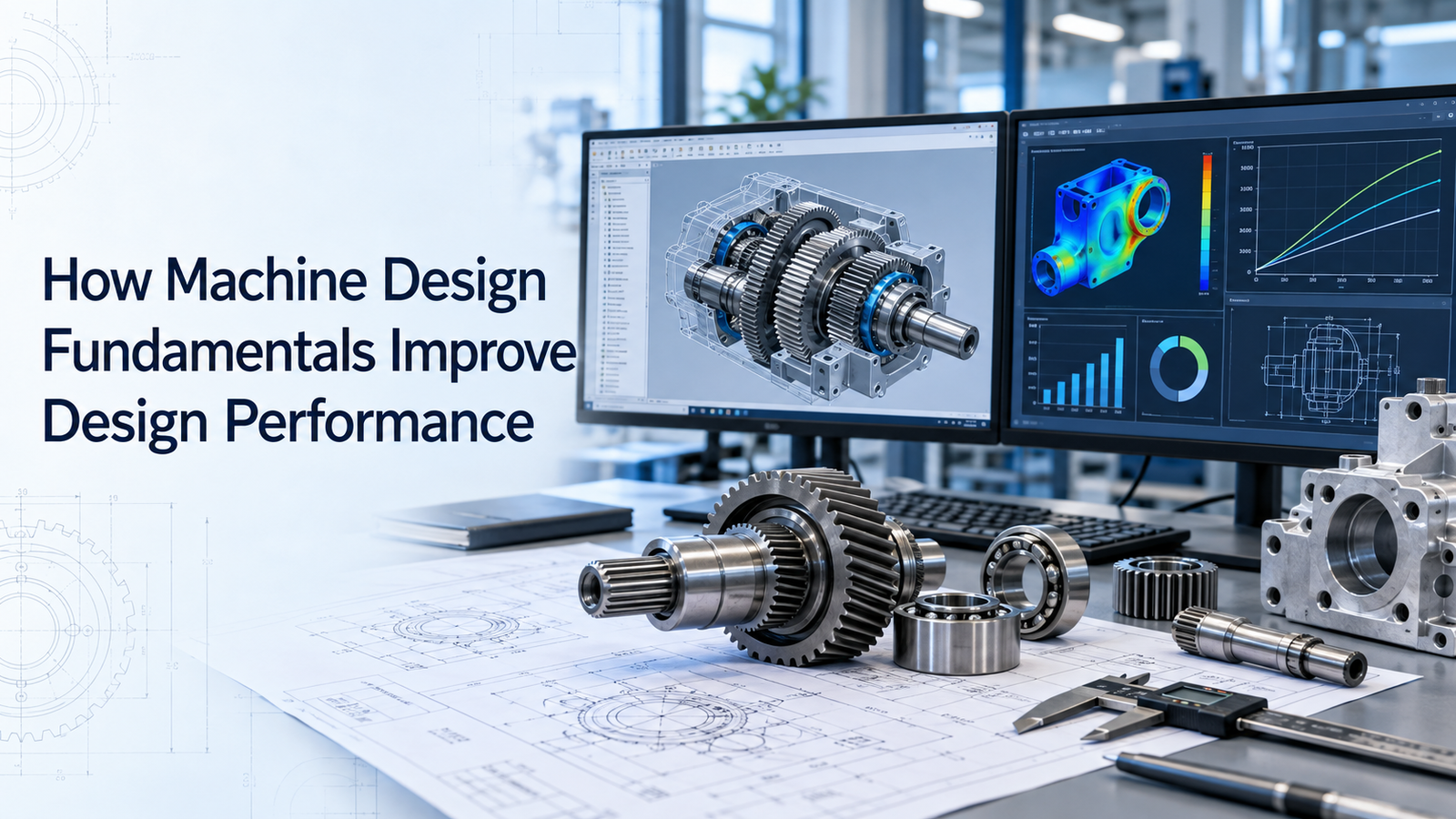
High-performing machines are not created simply by using larger motors, stronger frames, or more expensive components. Good performance comes from balancing load capacity, stiffness, motion, friction, inertia, accuracy, energy use, manufacturability, and cost.
This is where machine design fundamentals efficiency becomes important.
A well-designed machine uses the right amount of material, power, precision, and component capacity for the actual application. It responds faster, wastes less energy, produces less vibration, maintains alignment more accurately, and is easier to manufacture and maintain.
This guide explains how machine design fundamentals can be used to improve overall machine performance and efficiency.
Performance Improvement Steps
1. Define Performance Before Optimizing the Design
Optimization should begin with measurable requirements.
Important performance targets may include:
- Cycle time
- Positioning accuracy
- Repeatability
- Load capacity
- Maximum speed
- Acceleration
- Energy consumption
- Machine footprint
- Service life
- Maintenance interval
Without clear targets, designers may optimize the wrong part of the machine.
For example, reducing machine weight may look beneficial, but if the frame becomes too flexible, vibration and positioning error may increase.
The goal is therefore not simply to minimize weight or maximize speed.
The goal is to achieve the required performance with the best overall engineering balance.
2. Improve the Load Path
A load path describes how forces move through the machine structure.
Efficient machines transfer forces through short, direct, and stiff paths.
Poor load paths can create:
- Unnecessary bending
- Large moments
- Structural deflection
- Vibration
- Oversized frames
For example, placing a heavy actuator far from its support creates a larger bending moment than positioning it close to the structural support.
Designers should ask:
- Where does the force enter the machine?
- How does it travel through the frame?
- Where is it supported?
Reducing unnecessary offsets can improve stiffness without adding more material.
3. Optimize Stiffness-to-Weight Ratio
A machine frame should be rigid enough to maintain alignment while avoiding unnecessary mass.
Increasing material thickness everywhere is not always efficient.
Better methods may include:
- Box sections
- Ribs
- Gussets
- Shorter unsupported spans
- Better support locations
- Improved cross-sectional geometry
These features can increase stiffness significantly without adding excessive weight.
This is especially important in moving structures.
A lighter moving assembly can reduce:
- Motor torque
- Energy consumption
- Acceleration time
- Bearing load
The goal is high stiffness with controlled mass.
4. Reduce Moving Mass
Moving mass directly affects acceleration force.
For linear motion:
Force = Mass × Acceleration
If moving mass is reduced, the same actuator can accelerate the machine faster, or a smaller actuator may be used.
Mass can often be reduced by:
- Removing unnecessary material
- Using optimized structural shapes
- Relocating heavy components to fixed frames
- Using suitable lightweight materials
- Avoiding oversized moving components
However, weight reduction should not reduce required stiffness or fatigue life.
Optimization should always be verified by calculation or testing.
5. Control Rotational Inertia
Rotational inertia strongly affects motors, gearboxes, and servo systems.
Components such as:
- Pulleys
- Couplings
- Gears
- Rollers
- Shafts
can add significant inertia.
Higher inertia requires more torque during acceleration and deceleration.
Reducing unnecessary rotating mass can improve:
- Dynamic response
- Cycle time
- Motor sizing
- Energy use
- Position control
This is particularly important for indexing systems and high-speed automation.
6. Select Motors for the Actual Torque-Speed Requirement
Motor selection should not be based only on rated power.
The application may require:
- High starting torque
- Peak acceleration torque
- Continuous running torque
- Specific operating speed
A motor that is too small may overheat or fail to reach the required cycle time.
A motor that is much larger than necessary may increase:
- Cost
- Weight
- Inertia
- Drive size
Motor selection should therefore use the actual torque-speed profile and load inertia.
For dynamic applications, the complete motion cycle should be analyzed.
7. Reduce Mechanical Friction
Friction directly affects efficiency.
Sources may include:
- Bearings
- Linear guides
- Seals
- Sliding surfaces
- Gears
- Belts
Reducing unnecessary friction lowers drive force and heat generation.
Rolling-element guides are commonly used where low-friction, accurate linear motion is required.
THK describes linear guides as systems designed to support accurate linear motion and provides selection methods considering load, life, rigidity, preload, and environment.
Correct lubrication is also important because insufficient or unsuitable lubrication can increase friction and wear.
8. Optimize Linear Guide Preload
Preload can improve rigidity and running accuracy, but more preload is not always better.
THK notes that preload affects:
- Rigidity
- Running accuracy
- Load carrying behavior
- Service life
Higher preload reduces displacement under external load, but it also adds internal load.
This means excessive preload can increase friction and reduce life.
Select preload based on the actual rigidity and vibration requirement.
9. Reduce Misalignment
Misalignment increases friction, wear, heat, and vibration.
It can affect:
- Bearings
- Linear guides
- Couplings
- Gears
- Belts
Good alignment begins with design.
Use:
- Defined datums
- Machined reference surfaces
- Proper bearing spacing
- Correct tolerances
- Locating features
A well-aligned machine often runs more efficiently without changing the motor or control system.
10. Use Tolerances Strategically
Tighter tolerances are not automatically better.
Very tight tolerances can increase manufacturing cost and may create assembly problems.
Apply precision where it improves function.
Typical critical areas include:
- Bearing fits
- Linear guide mounting surfaces
- Shaft alignment
- Gear center distance
- Locating features
Less critical dimensions can use broader tolerances.
This approach improves manufacturing efficiency while preserving machine performance.
11. Control Vibration
Vibration reduces machine performance.
It can cause:
- Positioning errors
- Poor surface finish
- Noise
- Fastener loosening
- Fatigue
Common causes include:
- Imbalance
- Misalignment
- Flexible structures
- Resonance
- Poor bearing support
Vibration should be controlled through structural design, balance, support placement, and component selection.
Adding mass after commissioning is usually less effective than designing the structure correctly from the start.
12. Consider Thermal Performance
Heat changes dimensions and reduces efficiency.
Common heat sources include:
- Motors
- Bearings
- Gearboxes
- Friction
- Process equipment
Thermal expansion can affect:
- Alignment
- Accuracy
- Bearing clearance
- Guide preload
Designers should consider how the machine behaves after reaching operating temperature, not only when it is cold.
Heat should also be removed efficiently where required.
13. Choose Bearings for Efficiency and Life
Bearing selection affects both friction and reliability.
Evaluate:
- Load
- Speed
- Required life
- Lubrication
- Sealing
- Fits
- Temperature
SKF's bearing selection process emphasizes the relationship between operating conditions, load ratings, service life, lubrication, contamination, mounting, and maintenance.
A correctly selected bearing minimizes unnecessary resistance while supporting the required load and life.
14. Avoid Oversized Components
Oversizing one component can create a chain reaction.
For example:
- Larger carriage
- higher moving mass
- larger motor
- larger drive
- stronger frame
- higher cost
This is why optimization should consider the complete machine system.
Use appropriate engineering margins rather than selecting every component at the largest available size.
15. Standardize Where It Improves Efficiency
Standard components can improve design and manufacturing efficiency.
Examples include:
- Common fasteners
- Standard bearings
- Repeated brackets
- Standard sensors
- Common motor sizes
Benefits include:
- Faster design
- Lower inventory
- Easier procurement
- Simplified maintenance
However, standardization should not override the actual engineering requirement.
16. Optimize for Manufacturing
A highly optimized CAD model may still be expensive to manufacture.
Good design should also consider:
- Machining operations
- Welding access
- Standard material sizes
- Number of setups
- Inspection requirements
- Assembly sequence
Reducing unnecessary complexity can improve both cost and production time.
17. Include Safety in Optimization
Performance improvements should never create unacceptable risk.
ISO 12100:2010 remains the current published international standard for machinery risk assessment and risk reduction, although a new revision is under development.
When optimizing a machine, review whether changes affect:
- Stability
- Guarding
- Stored energy
- Speed
- Structural strength
- Failure modes
A faster machine may require different safety measures than a slower one.
Efficiency and safety must be considered together.
Machine Design Optimization Checklist
| Optimization Area | Key Question |
|---|---|
| Load path | Are forces transferred directly? |
| Moving mass | Can unnecessary weight be removed? |
| Inertia | Can rotating mass be reduced? |
| Stiffness | Is the structure rigid enough? |
| Friction | Are bearings and guides optimized? |
| Motor | Is torque correctly matched? |
| Alignment | Are datum surfaces well defined? |
| Tolerance | Is precision applied only where needed? |
| Vibration | Are structural sources controlled? |
| Thermal | Is expansion considered? |
| Manufacturing | Is the design easy to produce? |
| Safety | Do changes maintain risk reduction? |
Common Machine Optimization Mistakes
Avoid these mistakes:
- Optimizing without clear performance targets
- Reducing weight until stiffness becomes inadequate
- Selecting motors only by rated power
- Ignoring rotational inertia
- Using excessive guide preload
- Applying tight tolerances everywhere
- Oversizing every component
- Ignoring thermal expansion
- Trying to fix vibration only after manufacturing
- Improving speed without reviewing safety
Optimization is about balance rather than maximizing one parameter.
Conclusion
Good machine design fundamentals efficiency comes from treating the machine as one integrated system.
Load paths, stiffness, moving mass, inertia, friction, bearings, guides, motors, tolerances, vibration, thermal behavior, manufacturing, and safety all influence performance.
A high-performance machine is not necessarily the largest, strongest, or fastest design.
It is a machine that meets its required cycle time, accuracy, life, and reliability with appropriate use of material, energy, space, and cost.
By applying machine design fundamentals early, engineers can improve dynamic response, reduce power requirements, increase accuracy, simplify manufacturing, and lower lifecycle cost without sacrificing safety or reliability.