
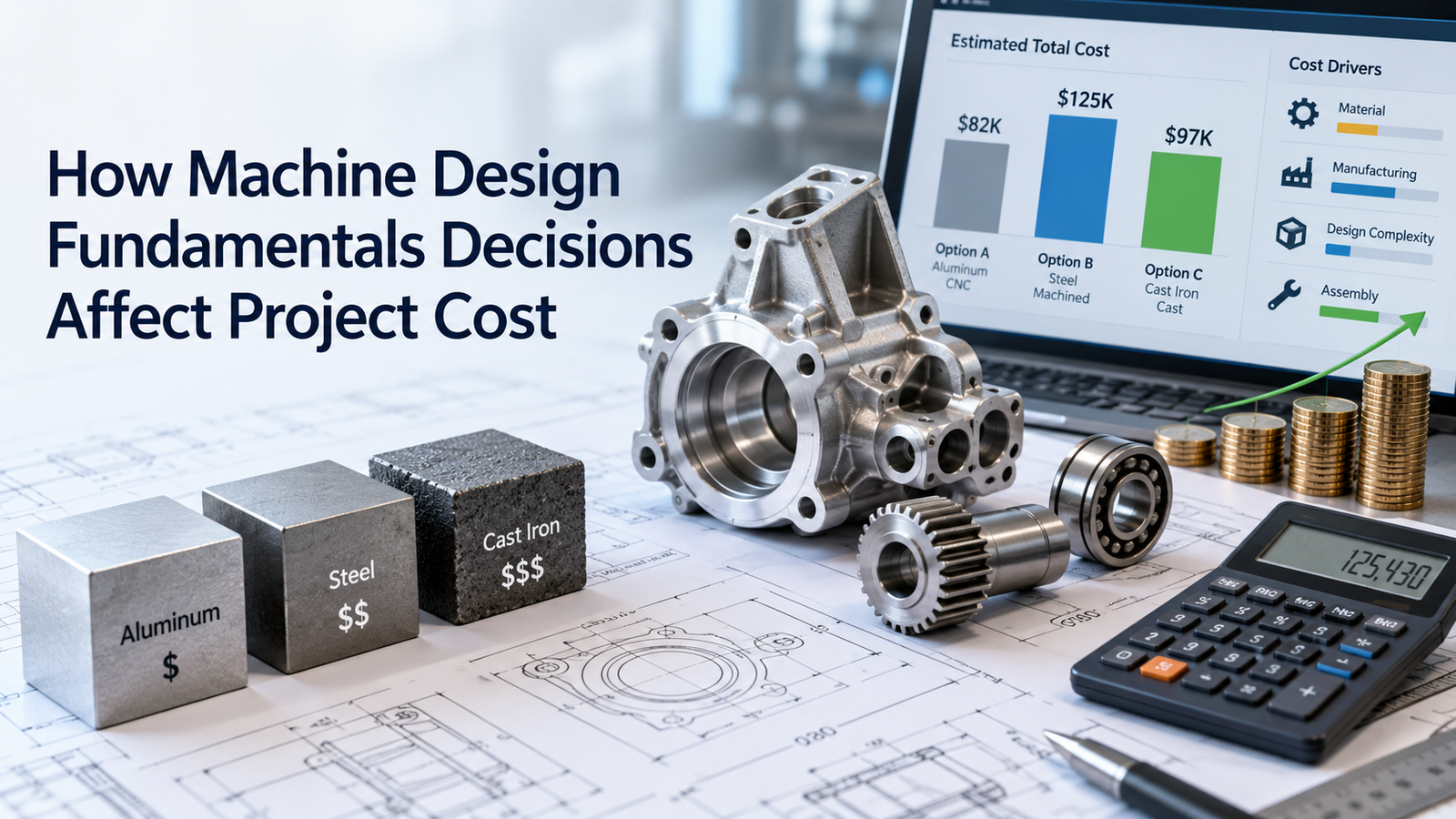
Machine design decisions have a direct impact on project cost.
The cost of a machine is not determined only by the price of motors, bearings, linear guides, frames, actuators, and other purchased components. Design choices also affect machining time, fabrication complexity, assembly labor, tolerances, testing, maintenance, energy use, spare parts, and future downtime.
This is why understanding machine design fundamentals cost is important for both engineers and procurement teams.
A low-cost component can increase total project cost if it requires more maintenance, causes repeated failures, or forces the machine to use larger supporting components. At the same time, excessive safety factors, unnecessarily tight tolerances, and oversized components can increase cost without improving actual performance.
This guide explains how core machine design decisions influence the total cost of an industrial project.
Key Cost Factors
1. Start With Clear Requirements
Poor requirements often lead to unnecessary cost.
Before selecting components, define:
- Load
- Speed
- Acceleration
- Accuracy
- Repeatability
- Cycle time
- Required service life
- Environment
- Safety requirements
- Available installation space
If requirements are vague, designers may compensate by oversizing components.
For example, if the actual payload is unknown, the designer may select a much larger linear guide and motor than necessary.
That may increase the cost of:
- Guides
- Motor
- Drive
- Frame
- Power supply
- Machine footprint
Clear requirements reduce uncertainty and help designers select the correct level of performance.
2. Oversizing Components Increases Cost
Oversizing is one of the most common cost drivers in machine design.
A larger component may appear safer, but it can create additional costs.
For example:
- Oversized carriage
- Higher moving mass
- Larger motor
- Larger drive
- Stronger frame
- Higher cost
THK notes that undersized linear guides can shorten service life while oversized guides add unnecessary cost, weight, and footprint. This illustrates why correct sizing is important for both reliability and economics. citeturn225906search5
The goal should be to select enough capacity with an appropriate engineering margin rather than simply choosing the largest available component.
3. Tight Tolerances Increase Manufacturing Cost
Tolerance decisions strongly influence machining cost.
Tighter tolerances can require:
- More precise machines
- Additional machining operations
- Slower cutting
- More inspection
- Higher rejection rates
- More skilled labor
Not every dimension needs high precision.
Tight tolerances are usually most important for functional interfaces such as:
- Bearing seats
- Shaft fits
- Linear guide mounting faces
- Locating features
- Gear center distances
SKF design guidance shows that shaft and bearing arrangements often require specific tolerance classes because fit directly affects bearing function. citeturn225906search13
Using precision only where it provides functional value can reduce manufacturing cost significantly.
4. Material Selection Affects More Than Raw Material Price
Material choice influences:
- Raw material cost
- Machining time
- Welding
- Weight
- corrosion resistance
- Surface treatment
- Service life
For example, stainless steel may be justified in corrosive or washdown environments but may be unnecessarily expensive for a dry indoor machine.
Aluminum can reduce moving mass but may require larger sections when stiffness is critical.
Material should therefore be selected based on total functional requirements rather than price per kilogram alone.
5. Complex Parts Increase Machining Cost
A highly complex custom component may require:
- Multiple machine setups
- Special tooling
- Five-axis machining
- Additional inspection
- Longer lead time
Designers should ask whether a complex machined part can be replaced by:
- Standard plate
- Welded fabrication
- Standard extrusion
- Purchased component
- Simpler geometry
Reducing unnecessary geometric complexity can lower both manufacturing cost and project lead time.
6. Standard Components Reduce Engineering and Procurement Cost
Using standard components can reduce:
- Design time
- Supplier search
- Manufacturing effort
- Spare-parts inventory
- Replacement lead time
Examples include:
- Bearings
- Fasteners
- Couplings
- Linear guides
- Motors
- Sensors
- Structural profiles
Standardization also simplifies maintenance.
However, standard components should not be used when they cannot meet the actual engineering requirement.
7. Component Life Influences Lifecycle Cost
Purchase price is only one part of cost.
A lower-cost component that requires frequent replacement may create higher total ownership cost.
THK explains that linear-guide life depends on applied load and operating conditions, and that factors such as vibration, shock, temperature, hardness, and contact conditions can alter service life. citeturn225906search0
Lifecycle cost can include:
- Replacement parts
- Labor
- Downtime
- Lost production
- Maintenance
This means a slightly more expensive component may be economically better if it provides significantly longer service life.
8. Bearing Selection Influences Maintenance Cost
Bearings that are incorrectly selected or installed can create recurring failures.
Bearing-related project cost includes:
- Initial bearing price
- Shaft machining
- Housing machining
- Lubrication
- Seals
- Replacement labor
- Downtime
SKF's lifecycle approach emphasizes extending operating life, reducing maintenance needs, improving energy efficiency, and lowering total cost of ownership through better design decisions. citeturn225906search12
Selecting bearings only by initial price can therefore be misleading.
9. Stiffness Decisions Affect Structural Cost
Designers sometimes increase material thickness everywhere to improve rigidity.
This can unnecessarily increase:
- Material cost
- Weight
- Machining
- Transport
- Motor requirements
Better stiffness can often be achieved through geometry.
Examples include:
- Box sections
- Ribs
- Gussets
- Shorter spans
- Better load paths
Good structural design can provide high rigidity with less material.
10. Moving Mass Affects Motor and Drive Cost
Moving mass directly affects acceleration force.
For linear motion:
Force = Mass × Acceleration
Reducing moving mass can reduce:
- Required motor torque
- Drive size
- Structural loads
- Energy consumption
This creates a cascading cost benefit.
However, weight reduction must not compromise required rigidity or fatigue strength.
11. Poor Load Paths Create Hidden Cost
An inefficient load path can create large bending moments and require heavier structures.
For example, placing a load far from its support increases moment loading.
A better layout may reduce the need for:
- Larger rails
- Larger bearings
- Thicker plates
- Larger frames
Simple geometric changes during concept design can sometimes save more money than negotiating a lower component price later.
12. Preload and Precision Should Match the Application
Higher precision and preload are not always better.
THK notes that preload improves rigidity but also creates internal load. citeturn225906search2
High-precision components may also cost more.
Specify:
- Accuracy
- Preload
- Surface finish
- Tolerance
based on the real process requirement.
A simple transfer mechanism does not need the same precision as semiconductor equipment.
13. Design for Manufacturing
Design for Manufacturing helps reduce unnecessary production cost.
Review:
- Number of machining operations
- Tool access
- Standard material sizes
- Welding complexity
- Setup count
- Inspection requirements
A design that is easy to machine and inspect will often cost less and have shorter lead time.
Production teams should be involved before drawings are released.
14. Design for Assembly
Assembly labor can become a significant project expense.
Design choices affect:
- Number of parts
- Fastener quantity
- Alignment effort
- Tool access
- Assembly sequence
Examples of cost-saving design include:
- Reducing unnecessary fasteners
- Using locating pins
- Designing self-locating features
- Improving tool clearance
The easier a machine is to assemble correctly, the lower the risk of rework.
15. Poor Maintainability Creates Long-Term Cost
A machine may be inexpensive to build but expensive to maintain.
Common problems include:
- Bearings hidden behind structures
- Motors impossible to remove directly
- Lubrication points blocked
- Belts difficult to tension
- Sensors difficult to access
SKF's lifecycle framework explicitly connects design decisions with operation, maintenance, repair, and total cost of ownership. citeturn225906search12
Maintenance access should therefore be reviewed during design.
16. Reliability Reduces Downtime Cost
Reliability has a strong financial impact.
A machine that fails frequently creates:
- Lost production
- Emergency maintenance
- Spare-part consumption
- Quality problems
THK notes that low-friction rolling mechanisms can reduce wear and replacement frequency in appropriate applications, which can lower maintenance cost. citeturn225906search4
A higher initial component price may therefore be justified when the cost of downtime is high.
17. Design Changes Become More Expensive Later
A design problem found during concept development may require only a drawing change.
The same problem found after machining may require:
- Scrapped parts
- Rework
- New components
- Delayed commissioning
The later a design error is discovered, the more expensive it usually becomes.
Structured design reviews help identify problems earlier.
18. Safety Decisions Also Affect Project Cost
Safety should never be removed simply to reduce cost.
However, integrating safety early is usually more efficient than adding it later.
ISO 12100 provides a risk-assessment and risk-reduction framework for machinery design.
Early safety planning can influence:
- Machine layout
- Guarding
- Access
- Stored-energy controls
- Maintenance areas
Adding these requirements after the mechanical design is complete may require major redesign.
19. Energy Consumption Is Part of Lifecycle Cost
Operating energy can become significant for machines running many hours per year.
Design choices affecting energy include:
- Motor efficiency
- Friction
- Moving mass
- Pneumatic consumption
- Hydraulic systems
An efficient machine may cost slightly more initially but reduce operating expense over its life.
Lifecycle analysis should therefore include energy, not only purchase cost.
20. Compare Total Cost of Ownership
A complete cost comparison should consider:
- Engineering
- Components
- Manufacturing
- Assembly
- Installation
- Energy
- Maintenance
- Spare parts
- Downtime
- Future modifications
SKF describes lifecycle costing as considering factors such as power consumption, maintenance, labor, tooling, cycle time, and other operating costs. citeturn225906search3turn225906search12
This provides a much better procurement picture than component price alone.
Machine Design Cost Checklist
| Design Decision | Cost Impact |
|---|---|
| Requirements | Prevents unnecessary oversizing |
| Component sizing | Controls hardware cost |
| Tolerances | Affects machining and inspection |
| Material | Affects price, weight and processing |
| Standardization | Reduces engineering and inventory |
| Service life | Affects replacement cost |
| Stiffness | Influences material use |
| Moving mass | Affects motor and drive size |
| Manufacturing | Controls production labor |
| Assembly | Controls build time |
| Maintenance | Affects future downtime |
| Reliability | Reduces unplanned losses |
| Safety | Early integration avoids redesign |
| Energy | Affects operating expense |
Common Cost-Related Design Mistakes
Avoid these mistakes:
- Oversizing every component
- Applying tight tolerances everywhere
- Selecting materials only by strength
- Using custom parts when standard parts work
- Ignoring component service life
- Creating difficult-to-machine geometry
- Ignoring assembly labor
- Designing without maintenance access
- Focusing only on purchase price
- Discovering safety requirements late
Cost-effective design does not mean choosing the cheapest component. It means achieving the required machine performance at the lowest practical total lifecycle cost.
Conclusion
Machine design decisions have a direct impact on both initial project cost and long-term ownership cost.
Good machine design fundamentals cost management begins with clear requirements, correct component sizing, appropriate tolerances, efficient material use, standardization, manufacturability, maintainability, and lifecycle thinking.
The cheapest design on the drawing is not always the cheapest machine to own.
A well-engineered machine may use slightly better components or require more design effort initially, but it can reduce machining, assembly, energy, maintenance, downtime, and future modification costs.
For procurement and engineering teams, the best approach is to evaluate the complete system rather than focusing only on individual component prices.