
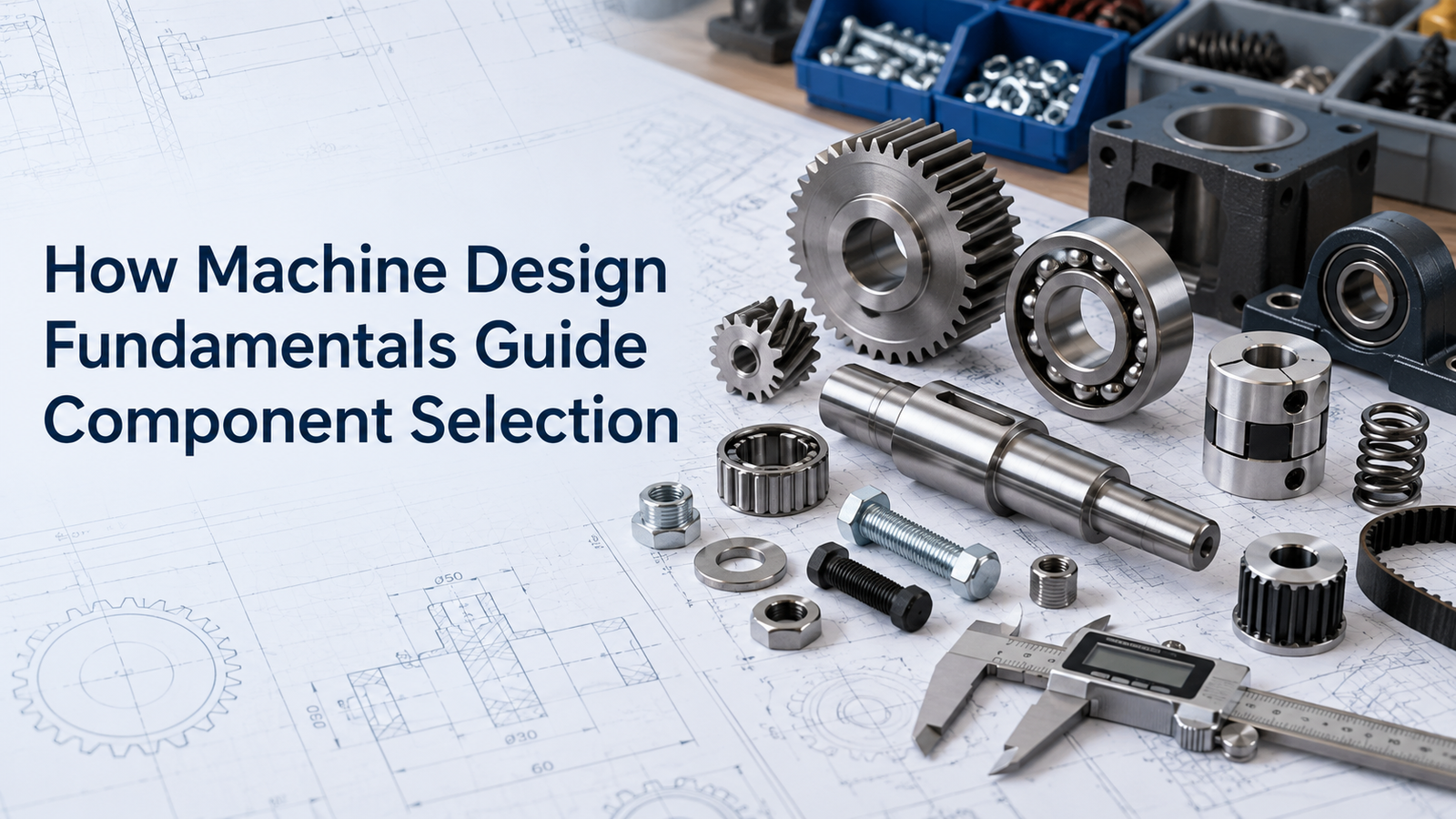
Choosing the right mechanical components is one of the most important parts of machine design. Bearings, shafts, linear guides, motors, actuators, fasteners, couplings, springs, gears, and structural materials must all work together under the actual operating conditions of the machine.
A component that is too small may fail early. A component that is unnecessarily large may increase cost, weight, inertia, power consumption, and machine size.
Good selection therefore begins with engineering fundamentals rather than a product catalog.
This machine design fundamentals selection guide explains how designers can use load, motion, speed, rigidity, accuracy, environment, safety, service life, and lifecycle cost to choose suitable machine components.
Key Steps and Considerations
1. Define the Machine Function First
Before choosing components, define what the machine must actually do.
Important questions include:
- What load must be moved or supported?
- What speed is required?
- What acceleration is required?
- What travel distance is needed?
- How accurate must positioning be?
- How many cycles will the machine perform?
- Is the motion rotary or linear?
- Is the load constant, variable, or shock-loaded?
- What operating environment will the machine experience?
For example, selecting a linear guide for a slow positioning table is different from selecting one for a high-speed pick-and-place system.
Similarly, a motor that works well at steady speed may not be suitable if the application requires rapid acceleration of a high-inertia load.
The machine function should therefore be converted into measurable engineering requirements before component selection begins.
2. Calculate the Real Load
Load is one of the most important selection parameters.
Designers should consider more than the normal operating load.
Possible loads include:
- Static load
- Dynamic load
- Shock load
- Radial load
- Axial load
- Moment load
- Inertial load
- Gravity load
For example, a linear guide supporting a moving carriage may experience vertical force from the carriage weight, moment load from an overhung payload, and additional forces during acceleration.
THK's linear guide selection process begins by defining operating conditions, calculating applied load, converting it to equivalent load, checking static safety, and comparing calculated service life with the required life.
This type of structured calculation is more reliable than choosing a component only from its maximum catalog load.
3. Consider Static and Dynamic Conditions Separately
A component may survive a static load but still fail early under repeated motion.
This is especially important for bearings and linear-motion components.
SKF recommends checking both static and dynamic bearing conditions. Bearing size under normal operation is commonly evaluated using rating life, while static safety must also be checked when stationary, moving slowly, or exposed to heavy peak loads.
This distinction applies broadly in machine design.
For example:
- Static strength asks whether the component can withstand the maximum load.
- Fatigue life asks how long it can survive repeated loading.
Both must be considered.
4. Use an Appropriate Safety Factor
The calculated working load should not normally be treated as the absolute design limit.
A safety factor provides margin for uncertainties such as:
- Unexpected overload
- Manufacturing variation
- Shock
- Vibration
- Misalignment
- Wear
- Unknown operating conditions
However, simply applying a very large safety factor to everything is not good engineering.
Oversizing can increase:
- Cost
- Weight
- Friction
- Inertia
- Energy consumption
- Machine footprint
The safety factor should reflect the consequence of failure, uncertainty in loading, material behavior, and applicable engineering standards.
5. Select Bearings Based on Load, Speed, and Life
Bearings support rotating components while reducing friction.
Bearing selection should consider:
- Radial load
- Axial load
- Speed
- Required life
- Lubrication
- Contamination
- Temperature
- Shaft and housing fits
- Misalignment
- Accuracy
SKF notes that bearing selection should account for load ratings and required service life, while lubrication, contamination, fits, sealing, mounting, and maintenance also affect final performance.
For a high-speed spindle, precision and lubrication may be especially important.
For a slow conveyor roller, load capacity and sealing may dominate.
The right bearing is therefore selected for the application, not simply by matching shaft diameter.
6. Size Shafts for Strength and Deflection
A shaft transfers torque and supports rotating components such as gears, pulleys, sprockets, and couplings.
Important shaft-design factors include:
- Torque
- Bending moment
- Combined stress
- Fatigue
- Deflection
- Critical speed
- Keyways
- Shoulder geometry
- Bearing locations
A shaft can be strong enough not to break but still deflect too much for accurate operation.
For example, excessive shaft deflection may cause:
- Gear misalignment
- Bearing overload
- Belt tracking problems
- Vibration
- Poor positioning accuracy
Machine design therefore requires checking both strength and stiffness.
7. Choose Linear Guides Based on Load and Rigidity
Linear guides are used in machine tools, automation equipment, packaging machinery, robots, inspection systems, and positioning tables.
Selection factors include:
- Load direction
- Moment load
- Number of blocks
- Required travel life
- Rigidity
- Accuracy
- Preload
- Speed
- Environment
THK's selection method includes applied load, equivalent load, static safety factor, average load, nominal life, environmental conditions, preload, and accuracy.
Preload can improve rigidity, but excessive preload increases internal loading and may reduce service life.
The correct guide therefore balances rigidity, friction, life, and accuracy.
8. Select Motors Using Torque, Speed, and Inertia
Motor selection is often misunderstood.
Power alone is not enough.
Important parameters include:
- Continuous torque
- Peak torque
- Speed
- Acceleration
- Duty cycle
- Load inertia
- Gear ratio
- Efficiency
- Starting requirements
ABB explains that motor selection should consider the load torque-speed curve and load inertia, particularly during starting and acceleration.
For example, a motor may provide enough power at steady speed but still fail to accelerate the load quickly enough.
Servo applications require even more attention to inertia matching and dynamic performance.
9. Match Actuator Type to the Motion Requirement
Common actuator options include:
- Pneumatic cylinders
- Hydraulic cylinders
- Electric cylinders
- Ball screw actuators
- Belt-driven actuators
- Servo actuators
Selection depends on:
- Required force
- Speed
- Stroke
- Positioning accuracy
- Repeatability
- Duty cycle
- Environment
- Energy efficiency
A pneumatic cylinder may be suitable for simple end-to-end movement.
A servo-driven ball screw may be better when accurate programmable positioning is required.
The best actuator is determined by motion requirements rather than technology preference.
10. Consider Acceleration and Inertia
Acceleration creates force.
For linear motion:
Force = Mass × Acceleration
For rotary motion, acceleration creates torque based on rotational inertia.
This becomes especially important in:
- Pick-and-place systems
- Indexing tables
- Robots
- Packaging machines
- High-speed conveyors
A component selected only for steady-state operation may be overloaded during acceleration or emergency stopping.
Design calculations should therefore include realistic motion profiles.
11. Check Rigidity, Not Only Strength
Rigidity describes how much a component deforms under load.
In precision machinery, small deformation can create significant errors.
Components where rigidity matters include:
- Machine frames
- Linear guides
- Shafts
- Bearing arrangements
- Tool holders
- Mounting plates
THK notes that preload can be used in linear guides to increase rigidity and reduce displacement, particularly in applications subject to vibration, impact, or high accuracy requirements.
A machine can be mechanically safe but still perform poorly if its structure is not stiff enough.
12. Define Accuracy and Repeatability
Accuracy and repeatability are not identical.
Accuracy describes how close the machine reaches the commanded position.
Repeatability describes how consistently it returns to the same position.
Different applications require different levels.
Examples include:
- Conveyor transfer: moderate accuracy
- Packaging machine: moderate to high repeatability
- Inspection equipment: high accuracy
- Precision machining: very high accuracy and rigidity
Higher precision components generally cost more.
Designers should specify only the accuracy actually required by the process.
13. Consider the Operating Environment
Industrial components do not operate in ideal laboratory conditions.
Environmental factors include:
- Dust
- Coolant
- Water
- Chemicals
- Corrosion
- Temperature
- Washdown
- Vibration
- Cleanroom requirements
These conditions influence:
- Material
- Coating
- Seal type
- Lubricant
- Enclosure
- Surface treatment
For example, food-processing equipment may require corrosion-resistant materials and washdown-compatible components.
A component suitable for a clean assembly machine may not survive in a metalworking environment exposed to chips and coolant.
14. Include Safety During Component Selection
Machine safety should be considered during the design stage.
ISO 12100:2010 provides principles for machinery risk assessment and risk reduction and remains the current published edition, although ISO is developing a revision.
Component selection may affect safety through:
- Structural strength
- Guarding
- Braking
- Stored energy
- Failure modes
- Motion limits
Designers should identify hazards and reduce risk through inherently safe design measures where practical before relying only on protective devices or warnings.
A mechanical component should therefore be evaluated not only for performance but also for the consequences of its failure.
15. Consider Maintenance and Service Life
Component selection affects future maintenance cost.
Evaluate:
- Lubrication frequency
- Replacement interval
- Accessibility
- Spare-part availability
- Supplier support
- Expected service life
A slightly more expensive component may reduce total ownership cost if it provides:
- Longer life
- Less lubrication
- Easier replacement
- Better sealing
- Lower downtime
This is particularly important for high-utilization machines where downtime costs far more than the component itself.
16. Avoid Oversizing Every Component
Oversizing can look like the safest approach, but it creates disadvantages.
A larger component may mean:
- Higher purchase cost
- Larger machine dimensions
- More weight
- Higher motor torque
- More structural load
- Higher inertia
For example, an oversized moving carriage may require a larger motor, larger drive, larger frame, and larger braking system.
One oversized component can therefore increase the size and cost of several other components.
Good design selects sufficient capacity with appropriate engineering margin.
17. Compare Total Lifecycle Cost
Component procurement should not focus only on purchase price.
Compare:
- Initial price
- Installation
- Maintenance
- Lubrication
- Energy consumption
- Replacement frequency
- Spare availability
- Downtime risk
A low-cost bearing that requires frequent replacement may be more expensive over the machine's life than a better-suited alternative.
The same principle applies to motors, actuators, linear guides, couplings, and other machine components.
Machine Component Selection Checklist
| Design Factor | Key Question |
|---|---|
| Function | What must the component do? |
| Load | What forces and moments occur? |
| Speed | What operating speed is required? |
| Acceleration | What dynamic loads occur? |
| Life | How many cycles or hours are required? |
| Rigidity | How much deflection is acceptable? |
| Accuracy | What positioning tolerance is required? |
| Environment | Dust, temperature, moisture, corrosion? |
| Safety | What happens if the component fails? |
| Maintenance | How often will it require service? |
| Expansion | Is future capacity required? |
| Cost | What is the lifecycle cost? |
Common Component Selection Mistakes
Avoid these mistakes:
- Selecting components only by maximum load rating
- Ignoring shock and acceleration
- Using motor power without checking torque and inertia
- Ignoring bearing life
- Selecting guides without checking moment loads
- Ignoring shaft deflection
- Over-specifying precision
- Forgetting environmental conditions
- Using excessive safety factors everywhere
- Comparing only purchase price
Good component selection requires the complete operating condition, not one catalog number.
Conclusion
Machine component selection begins with engineering fundamentals.
A reliable machine design fundamentals selection guide should consider function, load, motion, speed, acceleration, fatigue life, rigidity, accuracy, environment, safety, maintenance, and lifecycle cost.
Bearings should be selected for load, speed, life, lubrication, and operating conditions. Linear guides require load, moment, rigidity, preload, and life calculations. Motors require torque, speed, acceleration, and inertia analysis. Shafts must satisfy both strength and deflection requirements.
The goal is not to select the largest or most expensive component.
The goal is to select a component with enough capacity and performance for the real application while avoiding unnecessary cost, weight, and complexity.
A disciplined selection process at the beginning of machine design can reduce failures, improve accuracy, simplify maintenance, and produce a more efficient machine throughout its operating life.