
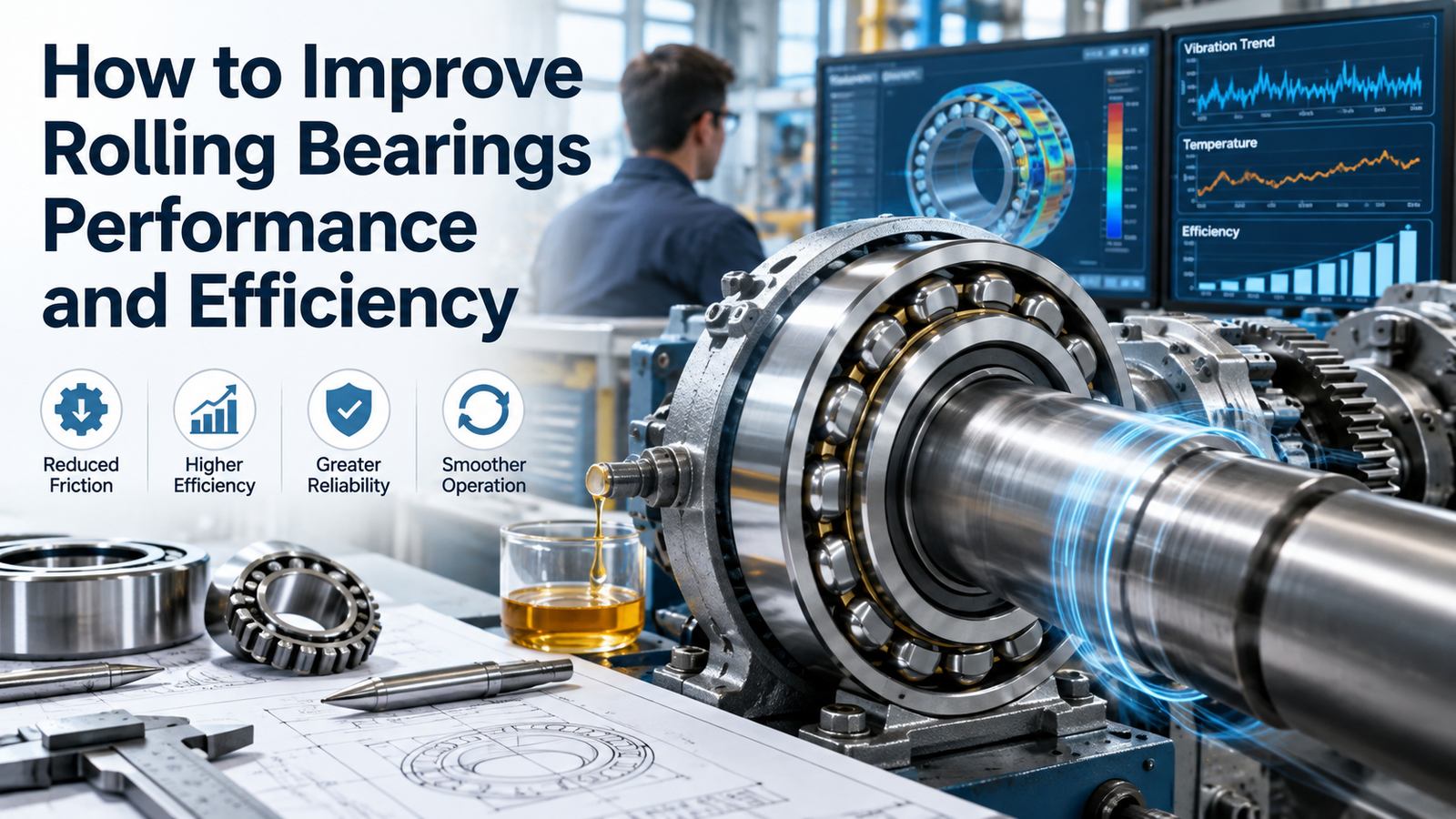
Rolling bearings are small components with a major influence on machine performance.
They support rotating or oscillating parts, reduce friction, guide shafts, and help maintain accurate motion. However, bearing performance depends on much more than selecting a bearing that physically fits the shaft and housing.
High rolling bearings efficiency requires the complete bearing system to be designed and maintained correctly.
Important factors include:
- Bearing type
- Load magnitude and direction
- Speed
- Internal clearance
- Preload
- Lubrication
- Fits
- Alignment
- Contamination control
- Mounting
- Operating temperature
- Condition monitoring
SKF notes that bearing selection should consider available space, loads, precision and stiffness, speed, temperature, vibration, contamination, and lubrication. NSK similarly emphasizes that mounting method strongly affects bearing accuracy, life, and performance.
This guide explains practical ways to improve rolling-bearing performance, reduce friction, control temperature, prevent premature damage, and improve long-term operating efficiency.
Performance Improvement Steps
1. Select the Correct Bearing Type
The first step in improving bearing performance is choosing a bearing suited to the application.
Common rolling-bearing types include:
- Deep groove ball bearings
- Angular contact ball bearings
- Cylindrical roller bearings
- Tapered roller bearings
- Spherical roller bearings
- Needle roller bearings
- Thrust bearings
Each type behaves differently under:
- Radial load
- Axial load
- Combined load
- Misalignment
- High speed
For example, a deep groove ball bearing may be suitable for moderate radial loads and some axial load, while a tapered roller bearing is often used when significant combined loading must be supported.
Selection should follow the actual operating condition rather than simply replacing an existing bearing with another bearing of similar dimensions.
2. Calculate Load Correctly
Bearing performance depends heavily on load.
Consider:
- Radial load
- Axial load
- Shock load
- Dynamic load
- Moment load
Underestimating the actual load can reduce bearing life.
ISO 281:2007 remains the currently published international standard for basic dynamic load ratings and rating-life calculation. It also includes modified rating-life concepts that consider factors such as lubrication condition and contamination.
A 2026 draft revision, ISO/DIS 281, is under development to replace ISO 281:2007, but it should not yet be treated as the published replacement.
3. Avoid Oversizing Without Reason
A larger bearing is not automatically more efficient.
Oversizing can increase:
- Cost
- Friction
- Rotating mass
- Space requirement
The objective is to select a bearing with sufficient capacity and reliability for the application without unnecessary size.
Use the required:
- Load capacity
- Speed capability
- Stiffness
- Life
as the basis for selection.
4. Check Operating Speed
Every bearing has speed limitations.
Higher rotational speed can increase:
- Friction
- Heat
- Lubricant stress
Bearing type, cage design, lubrication method, preload, and seal design all affect high-speed performance.
For high-speed machinery, engineers should consider the bearing and lubrication system together.
5. Use the Correct Lubricant
Lubrication separates rolling-contact surfaces and helps reduce:
- Friction
- Wear
- Heat
- Corrosion
SKF emphasizes that the correct amount of an appropriate lubricant is essential for maximizing bearing performance.
The lubricant must match:
- Speed
- Load
- Temperature
- Environment
Using the wrong lubricant can cause poor film formation or unnecessary friction.
6. Do Not Over-Lubricate
More grease is not always better.
Excessive grease can increase:
- Churning
- Friction
- Temperature
NSK identifies excessive lubricant as one possible cause of abnormal bearing temperature.
Follow the bearing and lubrication-system recommendations for:
- Initial grease fill
- Replenishment interval
- Replenishment quantity
7. Do Not Under-Lubricate
Insufficient lubrication can lead to:
- Metal-to-metal contact
- Surface damage
- Excessive wear
- Temperature rise
NSK lists poor lubrication and improper lubricant selection among causes of bearing damage such as flaking and scoring.
Lubrication should be treated as a controlled maintenance task rather than an occasional activity.
8. Choose Grease or Oil Based on the Application
Grease is widely used because it offers:
- Simple housing design
- Good sealing support
- Lower leakage risk
Oil may be preferable where the application requires:
- Higher speed
- Better heat removal
- Continuous circulation
- Contaminant removal
NSK notes that oil lubrication can provide stronger cooling and easier removal of foreign particles, while grease systems are generally simpler.
The correct system depends on the operating environment.
9. Keep Lubricant Clean
Contaminated lubricant can significantly reduce bearing life.
Particles can create:
- Indentations
- Surface damage
- Accelerated fatigue
SKF highlights cleanliness as a major influence on bearing service life.
Contamination can enter through:
- Poor seals
- Dirty grease tools
- Open housings
- Maintenance work
Use clean handling and effective sealing.
10. Improve Sealing
Seals have two important roles:
- Keep lubricant inside.
- Keep contaminants outside.
Poor sealing can allow:
- Dust
- Moisture
- Process debris
to enter the bearing.
Select sealing based on:
- Speed
- Contamination
- Temperature
- Lubricant type
Heavy contamination may justify stronger sealing even if friction increases slightly.
11. Use Correct Shaft and Housing Fits
Bearing rings must be correctly supported.
Incorrect fits can create:
- Creep
- Heat
- Ring distortion
- Poor load distribution
The required fit depends on factors such as:
- Which ring rotates relative to the load
- Load magnitude
- Bearing type
- Shaft and housing material
NSK notes that mounting method depends on both bearing type and fit.
Correct fits help maintain bearing geometry during operation.
12. Control Shaft and Housing Accuracy
Bearing performance depends on surrounding components.
Poor shaft or housing accuracy can create:
- Misalignment
- Uneven loading
- Vibration
NSK lists poor shaft or housing accuracy among possible causes of bearing flaking and scoring.
Control:
- Roundness
- Cylindricity
- Shoulder geometry
- Bore accuracy
The bearing cannot compensate for every error in the surrounding structure.
13. Improve Alignment
Misalignment can create uneven contact and abnormal load distribution.
Possible causes include:
- Shaft deflection
- Incorrect housing position
- Poor assembly
- Distorted frame
NSK identifies poor mounting and misalignment as possible causes of abnormal noise, temperature, and damage.
Alignment should be checked during installation and after structural changes.
14. Set Internal Clearance Correctly
Bearing internal clearance affects:
- Load distribution
- Heat
- Noise
- Stiffness
Too little clearance can increase:
- Friction
- Temperature
Too much clearance may reduce:
- Accuracy
- Stability
Interference fits and operating temperature can reduce the effective internal clearance after installation.
Selection should therefore consider the operating condition, not only the unmounted bearing clearance.
15. Use Preload Only Where Needed
Preload can improve:
- Stiffness
- Accuracy
- Position control
It is common in applications such as:
- Machine tool spindles
- Precision gearboxes
However, excessive preload can increase:
- Friction
- Heat
- Stress
NSK lists excessive preload among possible causes of scoring.
Preload should be based on the actual stiffness and accuracy requirement.
16. Mount Bearings Correctly
Incorrect mounting can damage a new bearing before the machine starts.
NSK recommends controlled mounting procedures and appropriate tools.
Possible mounting methods include:
- Press fitting
- Heating
- Hydraulic mounting
When press fitting, force should be applied to the ring being fitted rather than transmitted through the rolling elements.
Improper impact loading can damage raceways and rolling elements.
17. Avoid Hammering Bearings Directly
Direct hammer impact can cause:
- Brinelling
- Scratches
- Raceway damage
NSK recommends using appropriate mounting tools and presses where possible.
Even small installation damage can later appear as:
- Noise
- Vibration
- Premature failure
Correct mounting tools are a relatively small investment compared with unplanned bearing replacement.
18. Control Bearing Heating During Mounting
Large bearings are often heated to expand the inner ring before mounting.
NSK advises not heating bearings above 120 °C in its mounting guidance.
Use appropriate heating equipment such as induction heaters where suitable.
Avoid uncontrolled flame heating.
Uniform, controlled heating reduces the risk of damaging the bearing or lubricant.
19. Monitor Operating Temperature
Temperature is a useful bearing-health indicator.
After startup, bearing temperature should normally rise and reach a stable operating condition.
NSK notes that rapid abnormal temperature increase may indicate:
- Excess lubricant
- Insufficient clearance
- Incorrect mounting
- Excessive seal friction
Record normal operating temperature so abnormal changes are easier to identify.
20. Monitor Noise and Vibration
Abnormal bearing noise may indicate:
- Poor lubrication
- Misalignment
- Contamination
- Damage
NSK recommends monitoring abnormal sound and notes that vibration monitoring equipment can help identify irregular operating conditions.
For critical equipment, trend vibration over time rather than waiting for severe noise.
21. Use Condition Monitoring
Condition monitoring can include:
- Vibration
- Temperature
- Lubricant condition
- Noise
Trend data helps maintenance teams identify developing problems.
A single high reading may be less useful than a clear change from the machine's established baseline.
Condition-based maintenance can help replace bearings before catastrophic failure while avoiding unnecessary early replacement.
22. Control Operating Temperature
Excessive temperature affects:
- Lubricant viscosity
- Internal clearance
- Seal life
If temperature rises unexpectedly, investigate the root cause.
Potential causes include:
- Lubrication problem
- Excessive preload
- Incorrect fit
- Misalignment
- High load
Do not treat high temperature only as a cooling problem.
23. Prevent Electrical Damage
Bearings in motors and variable-speed-drive systems may be exposed to electrical currents.
Electrical erosion can damage raceways and create:
- Fluting
- Noise
- Vibration
Where the application presents electrical-current risk, consider suitable mitigation such as:
- Insulated bearings
- Shaft grounding
- Appropriate system design
ISO 281 rating-life calculation does not directly cover electrical erosion, so this failure mode should be addressed separately.
24. Improve Load Distribution
Uneven loading reduces performance.
Possible causes include:
- Housing distortion
- Shaft deflection
- Misalignment
- Incorrect preload
The surrounding structure should provide sufficient stiffness to keep the bearing loaded as intended.
Bearing optimization therefore includes:
- Shaft design
- Housing design
- Frame stiffness
not just the bearing itself.
25. Prevent Contamination During Maintenance
Many bearing problems begin during maintenance.
Good practices include:
- Clean tools
- Clean work area
- Covered lubricant containers
- Protected bearing packaging
NSK recommends keeping bearings packaged until immediately before mounting.
This reduces the chance that contamination enters before operation begins.
26. Use the Correct Relubrication Interval
Relubrication frequency depends on:
- Speed
- Temperature
- Bearing size
- Environment
- Contamination
NSK advises establishing routine grease-replenishment schedules, particularly where conditions are severe.
Too long an interval can result in lubricant degradation.
Too frequent or excessive replenishment can also create problems.
27. Use Automatic Lubrication Where Appropriate
Automatic lubrication can help in:
- Remote equipment
- Difficult-access locations
- Continuous-duty machinery
Benefits include:
- More consistent lubricant delivery
- Reduced manual maintenance
- Improved safety
The system still needs inspection because a blocked line or empty reservoir can create false confidence.
28. Inspect Bearings After Installation
After mounting, perform a controlled running test.
NSK recommends monitoring for:
- Abnormal noise
- Temperature rise
- Lubricant leakage
- Contamination
If abnormal conditions appear, stop and investigate before moving to full production.
This is especially important after:
- Bearing replacement
- Shaft repair
- Housing repair
- Machine rebuild
29. Analyze Failed Bearings
Do not throw away failed bearings before investigating them.
Inspect:
- Raceway patterns
- Discoloration
- Flaking
- Scoring
- Corrosion
- Mounting marks
NSK's bearing-damage guidance links different failure patterns to possible causes such as excessive load, misalignment, contamination, poor lubrication, unsuitable clearance, and inaccurate shaft or housing geometry.
Failure analysis can prevent repeated replacement of bearings without correcting the underlying problem.
Rolling Bearing Optimization Checklist
| Area | Optimization Action |
|---|---|
| Bearing type | Match load, speed and alignment |
| Load | Calculate realistic operating load |
| Lubrication | Select correct type and quantity |
| Sealing | Keep lubricant in and contamination out |
| Fits | Match shaft and housing conditions |
| Alignment | Reduce uneven loading |
| Clearance | Account for fit and temperature |
| Preload | Use only as required |
| Mounting | Use correct tools and methods |
| Temperature | Establish and monitor baseline |
| Vibration | Trend changes over time |
| Maintenance | Control relubrication and cleanliness |
Common Bearing Performance Mistakes
Avoid these mistakes:
- Selecting only by bore size
- Oversizing without a functional reason
- Using the wrong lubricant
- Over-greasing
- Ignoring contamination
- Using incorrect fits
- Running with poor alignment
- Applying excessive preload
- Hammering bearings during installation
- Ignoring abnormal temperature or noise
- Replacing bearings without failure analysis
- Treating every bearing failure as a bearing-quality problem
In many cases, bearing damage begins outside the bearing itself.
Conclusion
Improving rolling bearings efficiency requires optimizing the entire bearing system.
The most important actions are to:
- Select the correct bearing type.
- Calculate load realistically.
- Match the bearing to operating speed.
- Use the correct lubricant and quantity.
- Keep contamination out.
- Apply correct shaft and housing fits.
- Maintain alignment.
- Set suitable clearance and preload.
- Mount the bearing correctly.
- Monitor temperature, noise, and vibration.
- Analyze failures instead of simply replacing damaged bearings.
SKF and NSK guidance consistently shows that bearing performance depends on the interaction between the bearing, shaft, housing, lubrication, sealing, mounting, alignment, and operating environment. citeturn183695search37turn183695search0turn183695search2
ISO 281:2007 remains the current published standard for rolling-bearing dynamic load ratings and rating-life calculation as of September 2026. ISO/DIS 281 is under development as its replacement but is not yet the published edition. citeturn559506search2turn559506search0
The most efficient bearing is therefore not simply the bearing with the highest load rating.
It is the bearing that operates with the right load, fit, lubrication, alignment, cleanliness, and maintenance throughout its service life.