
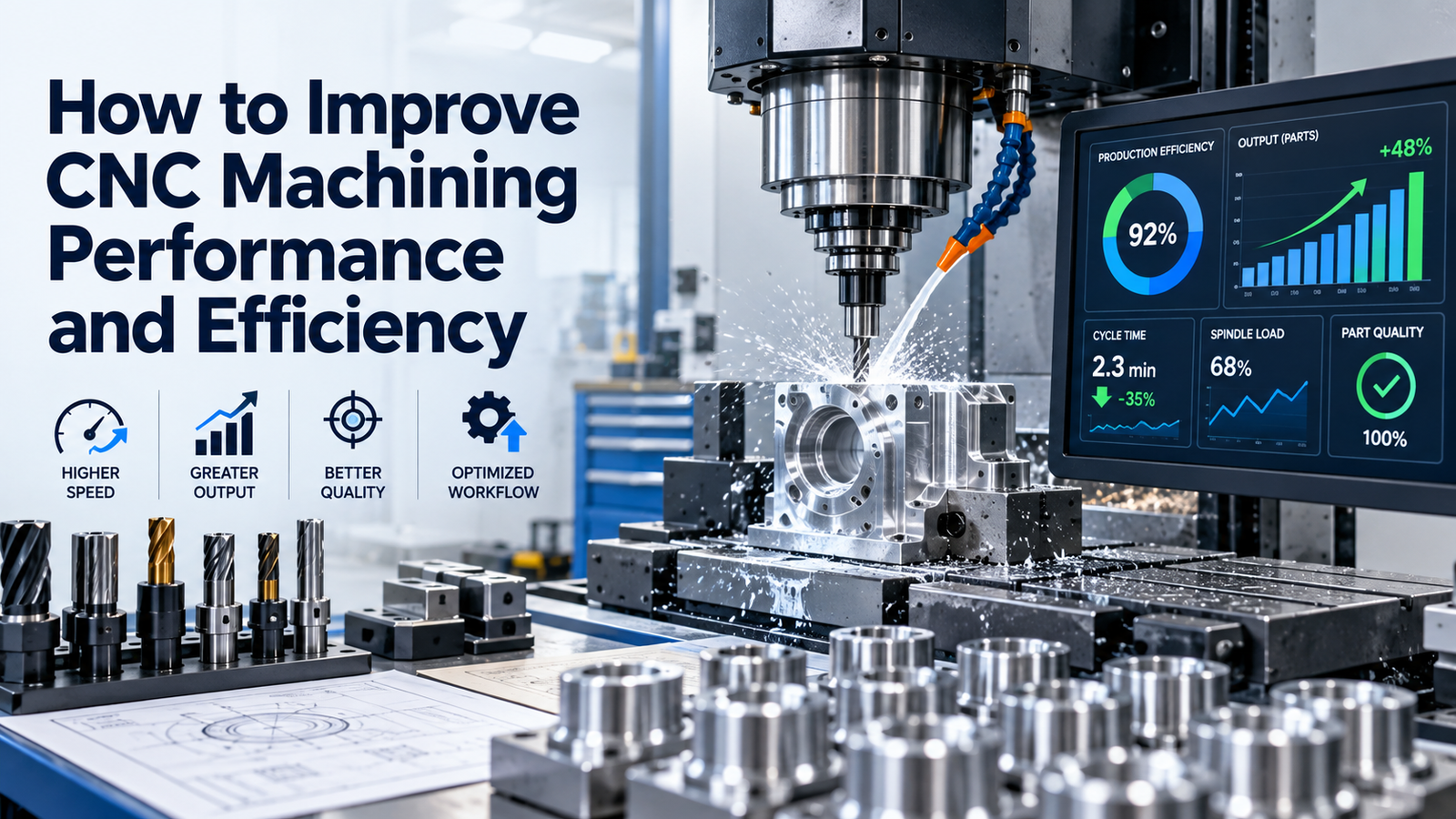
Improving CNC machining performance is not just about making the spindle rotate faster.
A productive CNC process should balance:
- Cycle time
- Tool life
- Part quality
- Machine utilization
- Setup time
- Scrap
- Operator effort
This is why CNC machining efficiency should be treated as a complete process-optimization problem rather than a single speed-and-feed adjustment.
A process that saves 20 seconds per part but doubles tool breakage may not actually be more efficient. Similarly, a conservative process with extremely long tool life may still waste capacity if cutting parameters are far below the machine and tool capability.
This guide explains practical ways to improve CNC machining performance and efficiency in milling and turning operations.
Performance Improvement Steps
1. Measure the Current Process First
Do not optimize without a baseline.
Record:
- Total cycle time
- Cutting time
- Tool-change time
- Setup time
- Tool life
- Scrap rate
- Rework
- Machine downtime
Break the cycle into individual operations.
For example:
| Operation | Time |
|---|---|
| Load and clamp | 45 sec |
| Rough milling | 120 sec |
| Finish milling | 60 sec |
| Drilling | 50 sec |
| Tool changes | 35 sec |
| Unload | 30 sec |
This immediately shows where improvement work should begin.
Reducing a five-second operation by 20% matters far less than reducing a two-minute operation by the same percentage.
2. Optimize Feeds and Speeds
Cutting parameters strongly affect:
- Material removal rate
- Tool wear
- Surface finish
- Heat generation
- Cutting force
Important variables include:
- Cutting speed
- Feed per tooth
- Feed per revolution
- Depth of cut
- Width of cut
Do not increase every value at once.
Change one parameter at a time and monitor:
- Spindle load
- Tool condition
- Surface quality
- Dimensional stability
The best parameters are those that deliver stable production, not simply the maximum possible cutting speed.
3. Maintain the Correct Chip Load
Chip load is critical in milling.
If chip load is too low:
- The tool may rub instead of cut efficiently.
- Heat may increase.
- Tool life may decrease.
If chip load is too high:
- Cutting forces increase.
- Chipping may occur.
- Tool breakage risk rises.
Maintaining a stable chip load helps the cutting edge work as intended.
4. Use Constant-Engagement Toolpaths
Traditional pocketing can produce large changes in cutter engagement, especially in corners.
This creates force spikes.
Modern strategies such as:
- Adaptive clearing
- Dynamic milling
- Trochoidal milling
aim to keep cutter engagement more consistent.
Benefits can include:
- More stable cutting
- Higher allowable feeds
- Better tool life
- Lower chatter risk
For many roughing applications, improving engagement consistency is more valuable than simply increasing spindle speed.
5. Reduce Air Cutting
Air cutting is machine movement without material removal.
Examples include:
- Long rapid moves
- Unnecessary retracts
- Excessive safe heights
- Inefficient approach paths
Review CAM output carefully.
Possible improvements include:
- Shorter linking moves
- Optimized retract heights
- Better operation sequencing
- Reduced tool travel
Small reductions repeated hundreds of times can significantly reduce total cycle time.
6. Reduce Tool Changes
Every tool change adds non-cutting time.
Review whether operations can be combined.
For example:
- Can one end mill perform roughing and semi-finishing?
- Can a multifunction tool replace several tools?
- Can operation order reduce repeated tool calls?
However, do not combine operations if the resulting compromise reduces quality or tool life.
7. Improve Tool Selection
The right cutting tool can improve both productivity and consistency.
Consider:
- Tool material
- Coating
- Geometry
- Number of flutes
- Tool diameter
- Insert grade
A tool designed for the workpiece material can often allow better cutting conditions than a general-purpose tool.
Tool manufacturers increasingly develop grades and geometries specifically for difficult alloys and high-productivity applications.
8. Minimize Tool Overhang
Long tool overhang reduces rigidity.
This can cause:
- Chatter
- Deflection
- Poor surface finish
- Reduced allowable feed
Use the shortest practical tool and holder combination.
Higher rigidity may allow:
- Greater depth of cut
- Higher feed
- Better surface finish
Improving rigidity is often more effective than reducing cutting parameters.
9. Improve Toolholder Quality
Toolholders affect:
- Runout
- Balance
- Rigidity
- Repeatability
Poor runout causes unequal flute loading.
One flute may carry most of the cutting load, reducing tool life and surface quality.
Keep:
- Tool tapers clean
- Collets clean
- Holders undamaged
For high-speed machining, holder balance becomes increasingly important.
10. Optimize Workholding
Weak workholding limits cutting performance.
A workpiece that moves or vibrates forces the programmer to use conservative cutting conditions.
Good workholding should provide:
- High rigidity
- Repeatable location
- Fast loading
- Tool access
Possible improvements include:
- Better fixtures
- Soft jaws
- Zero-point systems
- Modular fixtures
- Hydraulic or pneumatic clamping
The goal is to shorten setup time while maintaining rigidity.
11. Reduce Setup Time
Setup time can dominate low-volume production.
A machine may cut efficiently but remain underutilized because operators spend too long on changeovers.
Use:
- Standard fixture locations
- Preset tools
- Offline tool measurement
- Setup sheets
- Repeatable work offsets
SMED-style thinking can also help separate internal and external setup tasks.
Prepare as much as possible while the machine is still running.
12. Improve Chip Evacuation
Poor chip evacuation reduces efficiency by causing:
- Recutting
- Tool damage
- Surface defects
- Machine stoppages
Improve:
- Coolant direction
- Air blast
- Chipbreaker selection
- Toolpath
Deep pockets and difficult materials need special attention.
A fast toolpath is not efficient if operators frequently stop the machine to clear chips.
13. Optimize Coolant Delivery
Coolant can support:
- Heat control
- Lubrication
- Chip evacuation
- Tool life
Check:
- Coolant concentration
- Nozzle direction
- Flow
- Pressure
- Filtration
The coolant must reach the cutting zone.
Poor coolant delivery can limit the performance of otherwise good cutting parameters.
14. Track Tool Life
Do not replace tools only after failure.
Track:
- Number of parts
- Cutting time
- Wear condition
A controlled tool-life strategy reduces:
- Unexpected breakage
- Scrap
- Unplanned downtime
Tool-life data can also reveal whether process changes improve or hurt overall efficiency.
15. Use Tool-Wear Compensation
Some dimensions gradually drift as the tool wears.
Tool-wear offsets can compensate for predictable change.
This is useful for high-volume production where:
- Diameter
- Length
- Surface location
changes gradually during a tool's life.
Small controlled compensation can extend usable tool life while maintaining tolerance.
16. Optimize Roughing and Finishing Separately
Roughing and finishing have different objectives.
Roughing focuses on:
- High material removal
- Stability
- Tool life
Finishing focuses on:
- Accuracy
- Surface quality
Do not force one tool or cutting strategy to optimize both if separate operations deliver better overall performance.
17. Use the Machine's Available Power Efficiently
Monitor spindle load during cutting.
Very low spindle load may indicate the process is too conservative.
Extremely high or unstable load may indicate:
- Excessive engagement
- Poor tool condition
- Chatter risk
The goal is stable use of available machine capability.
18. Reduce Unnecessary Finishing Passes
Some programs include multiple finishing passes because of historical process adjustments.
Review whether each pass is still needed.
A stable roughing or semi-finishing operation may allow one final finishing pass instead of several.
However, verify:
- Size
- Surface finish
- Geometric tolerance
before removing operations.
19. Optimize Hole-Making Operations
Drilling can consume a significant portion of cycle time.
Review:
- Drill type
- Peck cycle
- Retract distance
- Cutting speed
- Feed
Some modern drills can machine deeper holes with fewer pecks under suitable conditions.
Avoid unnecessary full retracts when the tool and chip-control strategy allow a more efficient cycle.
20. Reduce Machine Downtime
High cutting performance has little value if the machine spends too much time stopped.
Track downtime reasons such as:
- Tool shortage
- Program issues
- Fixture problems
- Maintenance
- Material waiting
- Operator waiting
Pareto analysis can identify the largest downtime contributors.
21. Use Preventive Maintenance
Machine condition directly affects productivity.
Check:
- Lubrication
- Spindle condition
- Way covers
- Coolant system
- Filters
- Tool changer
Poor maintenance can create:
- Accuracy loss
- Unexpected failure
- Reduced spindle performance
Preventive maintenance protects both machine availability and process capability.
22. Monitor Spindle and Tool Performance
Modern CNC systems can provide useful data such as:
- Spindle load
- Cycle time
- Tool usage
- Alarms
Use trends rather than isolated readings.
For example, increasing spindle load over several batches may indicate:
- Tool wear
- Material variation
- Lubrication issue
Monitoring helps identify performance loss before it becomes downtime.
23. Standardize Successful Parameters
When an optimized process works, document it.
Store:
- Tool number
- Tool grade
- Cutting parameters
- Workholding
- Coolant setup
- Tool-life target
This prevents future operators or programmers from restarting optimization from zero.
24. Balance Tool Life and Productivity
Maximum tool life does not always produce minimum cost per part.
Likewise, maximum material removal rate does not always produce the best economics.
An aggressive process may create:
- More frequent tool changes
- Tool breakage
- Scrap risk
A very conservative process may waste machine capacity.
The optimum point balances:
- Cycle time
- Tool consumption
- Quality
- Reliability
CNC Efficiency Improvement Checklist
| Area | Improvement Opportunity |
|---|---|
| Cycle time | Remove non-cutting moves |
| Roughing | Constant engagement |
| Tooling | Correct grade and geometry |
| Toolholding | Reduce runout and overhang |
| Workholding | Increase rigidity |
| Setup | Standardize and preset |
| Coolant | Improve delivery |
| Chips | Improve evacuation |
| Tool life | Monitor and compensate |
| Machine | Preventive maintenance |
| Programming | Optimize operation sequence |
| Production | Track downtime |
Common CNC Optimization Mistakes
Avoid these mistakes:
- Increasing speed without checking tool life
- Reducing cycle time while increasing scrap
- Ignoring workholding rigidity
- Running tools until failure
- Using excessive tool overhang
- Accepting unnecessary air cutting
- Optimizing cutting but ignoring setup time
- Ignoring chip evacuation
- Making multiple process changes at once
- Failing to document successful settings
A stable, repeatable process is usually more valuable than a highly aggressive process that frequently fails.
Conclusion
Improving CNC machining efficiency requires optimization of the complete manufacturing process.
The biggest opportunities often come from:
- Measuring the current cycle.
- Optimizing feeds and speeds.
- Maintaining correct chip load.
- Using constant-engagement toolpaths.
- Reducing air cutting.
- Improving tooling and workholding.
- Reducing setup time.
- Improving coolant and chip evacuation.
- Managing tool life.
- Reducing downtime through maintenance and monitoring.
Modern tooling can also create meaningful productivity gains when the grade and cutting strategy match the application. For example, Sandvik Coromant has published application examples where newer grades improved tool life and productivity in specific difficult-material tests, illustrating why tooling selection should be evaluated together with cutting data rather than in isolation.
The most efficient CNC process is not necessarily the fastest individual cut.
It is the process that consistently produces good parts with high machine utilization, predictable tool life, minimal downtime, and low scrap.