
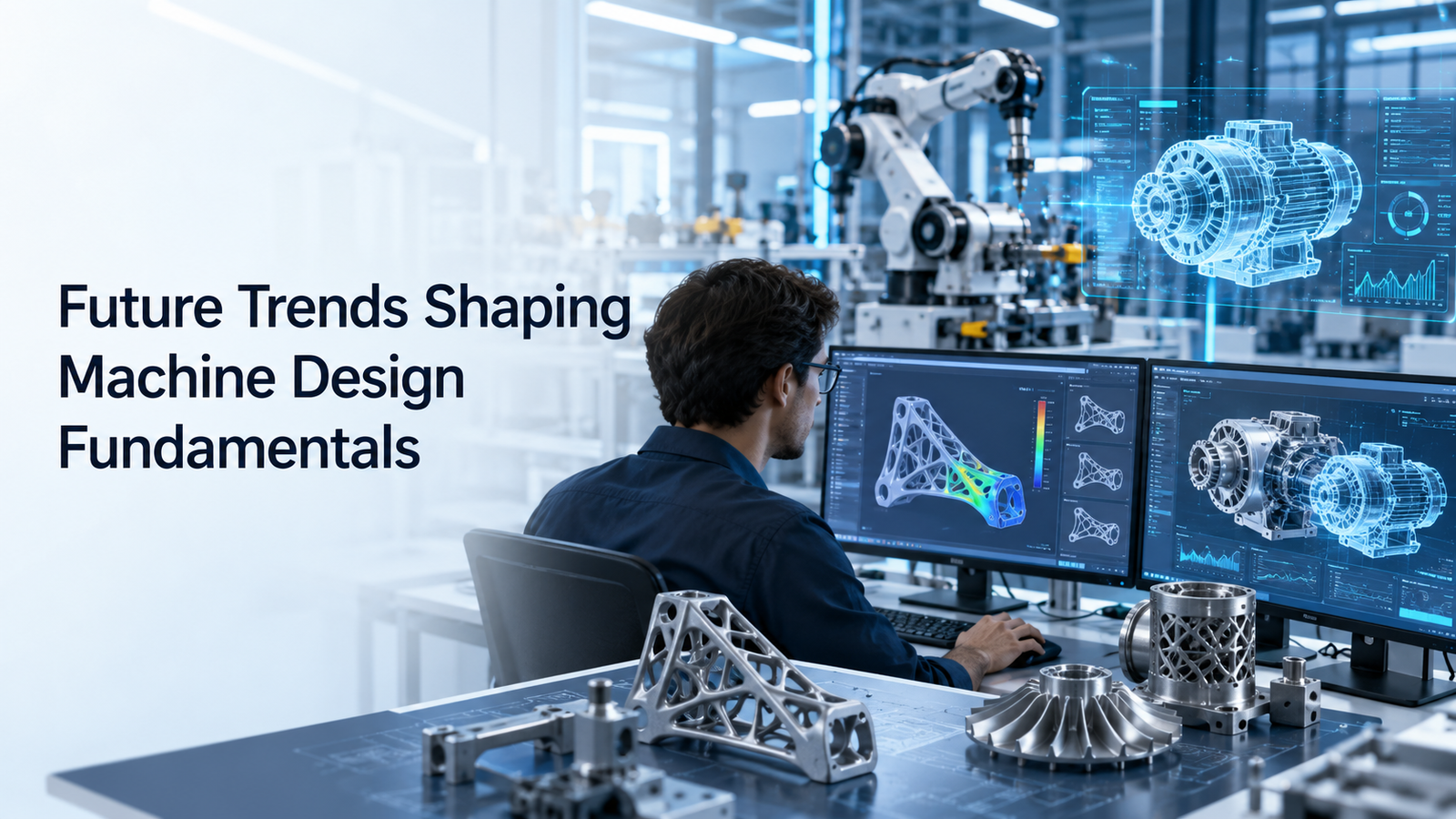
Machine design is changing quickly. Traditional mechanical engineering fundamentals such as load calculation, material selection, stiffness, fatigue, tolerances, and safety remain essential, but they are increasingly supported by digital tools, artificial intelligence, simulation, advanced manufacturing, and connected data.
The future of machine design is not about replacing engineering fundamentals. It is about applying them with better tools, faster feedback, and more complete lifecycle information.
Current machine design fundamentals trends show a clear shift toward digital twins, AI-assisted engineering, simulation-led development, additive manufacturing, connected sensors, sustainable design, and integrated mechanical-electrical-software workflows.
For machine builders and engineers, understanding these trends can help reduce development time, improve reliability, and create equipment that is easier to optimize throughout its operating life.
Key Technology Trends
1. Digital Twins Are Becoming Core Design Tools
Digital twins are moving beyond simple 3D models.
A modern digital twin can combine:
- Mechanical design
- Electrical systems
- Automation logic
- Simulation
- Manufacturing data
- Sensor information
- Service data
NIST's 2026 digital twin work highlights their potential to improve design, production, and lifecycle management while also identifying challenges around interoperability, cybersecurity, validation, and workforce readiness.
For machine designers, digital twins can support:
- Virtual testing
- Design comparison
- Motion analysis
- Performance prediction
- Maintenance planning
This allows engineering teams to find problems before physical hardware is built.
2. Simulation-Led Design Will Increase
Traditional workflows often follow:
- Design
- Build
- Test
- Modify
Future workflows increasingly use:
- Design
- Simulate
- Optimize
- Build
Simulation can help evaluate:
- Stress
- Deflection
- Vibration
- Thermal behavior
- Motion
- Fluid flow
Using simulation early can reduce physical prototypes and redesign.
Siemens describes comprehensive digital twins as environments that support “what-if” analysis and cross-domain optimization before physical implementation.
This can be particularly valuable for complex machinery with mechanical, electrical, and software interactions.
3. Artificial Intelligence Will Support Engineering Decisions
AI is beginning to influence machine design through:
- Design suggestions
- Automated optimization
- Failure prediction
- Material selection
- CAD assistance
- Engineering documentation
NIST's 2026 roadmap for AI and machine learning in smart manufacturing identifies AI as an important technology for areas including digital twins, robotics, additive manufacturing, sensing, and autonomous systems.
AI can help engineers process large amounts of design and operating data.
However, engineers still need to validate results using physics, standards, testing, and professional judgment.
4. Generative Design Will Expand
Generative design uses algorithms to create and compare many design alternatives based on constraints.
Inputs may include:
- Load
- Material
- Manufacturing method
- Weight target
- Safety factor
- Space
The software can then propose optimized geometries.
Potential benefits include:
- Lower weight
- Better material use
- Higher stiffness-to-weight ratio
- Reduced part count
Generative design is especially powerful when combined with additive manufacturing, because complex shapes can be produced that would be difficult using traditional machining.
5. Additive Manufacturing Will Influence Component Design
Additive manufacturing enables new mechanical designs.
Engineers can create:
- Internal channels
- Lightweight lattice structures
- Consolidated assemblies
- Complex cooling passages
- Customized components
Recent industry developments increasingly connect additive manufacturing with AI, digital twins, and software-defined manufacturing.
This changes the design question from:
How can this part be machined?
to:
What geometry best performs the required function?
However, additive manufacturing still requires careful consideration of material properties, orientation, post-processing, inspection, and cost.
6. Design for Additive Manufacturing Will Become More Important
Traditional Design for Manufacturing rules are changing.
For additive processes, designers need to consider:
- Build orientation
- Support structures
- Surface finish
- Minimum wall thickness
- Internal geometry
- Post-processing
The ability to produce complex shapes does not mean every design should be complex.
Engineers must balance performance with manufacturability and inspection.
7. Sensor-Integrated Machines Will Become Standard
Machines are increasingly designed with sensing built into the structure.
Common sensors include:
- Vibration
- Temperature
- Load
- Position
- Pressure
This data can be used for:
- Condition monitoring
- Predictive maintenance
- Performance optimization
- Digital twin updates
Future machine design may include sensor locations as part of the original mechanical architecture rather than adding sensors later.
This makes machines more observable and easier to maintain.
8. Predictive Design Will Use Field Data
Traditional machine design often ends at commissioning.
Future engineering will increasingly use operational data to improve the next design.
For example:
- Bearing temperature
- Vibration
- Motor load
- Cycle time
- Failure history
can reveal how the machine performs under real conditions.
This creates a feedback loop:
- Design
- Build
- Operate
- Collect Data
- Improve Design
Digital thread concepts support this continuous connection between design and operation.
Siemens describes the digital thread as an information backbone that allows operational insights and performance data to feed back into future engineering decisions.
9. Mechanical, Electrical, and Software Design Will Converge
Modern machines combine:
- Mechanics
- Electrical systems
- PLC control
- Motion control
- Sensors
- Software
- Networking
Future machine design will increasingly require multi-domain collaboration.
A mechanical change may affect:
- Motor torque
- Control tuning
- Sensor location
- Safety logic
Integrated engineering platforms can help teams work from a common data model.
This can reduce late-stage integration problems.
10. Model-Based Systems Engineering Will Grow
Model-Based Systems Engineering (MBSE) uses structured digital models to describe system requirements, interfaces, and behavior.
For complex machines, MBSE can help manage:
- Requirements
- Subsystems
- Interfaces
- Verification
- Change impact
This is particularly useful for machines combining many disciplines.
Future design teams may use system-level models before detailed mechanical CAD begins.
11. Lightweight Design Will Become More Strategic
Reducing unnecessary mass improves:
- Acceleration
- Energy efficiency
- Motor sizing
- Structural load
Future lightweight design will use:
- Topology optimization
- Advanced materials
- Generative design
- Additive manufacturing
The goal is not simply lighter machines.
It is better stiffness-to-weight and performance-to-weight ratios.
12. Sustainable Design Will Influence Component Decisions
Sustainability is becoming part of engineering decision-making.
Designers may increasingly evaluate:
- Material use
- Recyclability
- Energy consumption
- Component life
- Repairability
- Remanufacturing
NIST's AI roadmap also identifies sustainable manufacturing as an important smart-manufacturing direction.
A machine that uses less energy and lasts longer may provide both environmental and economic benefits.
13. Modular Machine Architecture Will Expand
Modular design allows machines to be built from standardized functional units.
Examples include:
- Conveyor module
- Inspection module
- Robotic loading module
- Vision module
Benefits include:
- Faster engineering
- Easier upgrades
- Reduced spare-part variety
- Simplified maintenance
Modular designs also help manufacturers create multiple machine versions from a common platform.
14. Virtual Commissioning Will Reduce Startup Risk
Virtual commissioning uses simulation to test machine behavior before the physical system is complete.
It can help verify:
- Motion
- Sequences
- Interlocks
- Control logic
- Cycle time
This can reduce commissioning time and identify integration problems earlier.
Digital twins are making virtual commissioning more practical for machine builders.
15. Cybersecurity Will Influence Machine Architecture
Connected machines create new cybersecurity considerations.
Future design decisions may need to consider:
- Secure communication
- Network segmentation
- Remote access
- Software updates
- Authentication
Cybersecurity is becoming part of machine architecture, not only an IT issue.
This is particularly important as machines connect to cloud platforms and remote-service systems.
16. AI-Assisted Maintenance Will Influence Design
Future machines may be designed specifically for AI-based maintenance.
This may require:
- Additional sensors
- Better data access
- Standardized interfaces
- Historical data
AI systems can analyze machine behavior and identify abnormal patterns.
Designers may therefore consider data quality and observability as design requirements.
17. Human-Centered Machine Design Will Grow
Future machines will place more emphasis on:
- Ergonomics
- Accessibility
- Operator information
- Maintainability
- Safety
As automation becomes more advanced, human interaction becomes more important rather than less.
Designers must consider how operators and maintenance teams interact with complex equipment.
18. Open Standards Will Improve Interoperability
Future machinery will increasingly need to exchange data across platforms.
Open standards can improve:
- Interoperability
- Digital twin integration
- Data exchange
- Vendor flexibility
NIST's 2026 digital twin research identifies interoperability and standards development as important areas for scalable digital twin adoption.
Key Machine Design Trends at a Glance
| Trend | Expected Impact |
|---|---|
| Digital twins | Better virtual testing |
| Simulation-led design | Less physical redesign |
| AI-assisted engineering | Faster analysis |
| Generative design | Optimized geometry |
| Additive manufacturing | New component shapes |
| Smart sensing | Better machine visibility |
| Digital thread | Lifecycle feedback |
| Multi-domain engineering | Better integration |
| MBSE | Stronger system planning |
| Lightweight design | Better dynamic performance |
| Sustainable design | Lower lifecycle impact |
| Modular machines | Easier upgrades |
| Virtual commissioning | Faster startup |
| Cybersecurity | Safer connectivity |
| Human-centered design | Better usability |
| Open standards | Improved interoperability |
What Should Machine Designers Learn Next?
Future machine designers will still need strong fundamentals.
Important skills include:
- Mechanics
- Materials
- Fatigue
- Machine elements
- CAD
- Simulation
But additional useful areas include:
- Digital twins
- AI
- Data analytics
- Additive manufacturing
- Sensor technology
- Systems engineering
- Cybersecurity
The strongest engineers will combine mechanical fundamentals with digital engineering tools.
Conclusion
The future of machine design is increasingly digital, connected, and data-driven.
Important machine design fundamentals trends include digital twins, simulation-led engineering, artificial intelligence, generative design, additive manufacturing, sensor integration, digital threads, multi-domain engineering, sustainability, and virtual commissioning.
These technologies will not replace mechanical engineering fundamentals.
Load paths, stiffness, fatigue, tolerances, materials, safety, and reliability will remain essential.
What will change is how engineers apply those fundamentals.
Future machine designers will be able to test more ideas virtually, use real operating data to improve designs, and connect mechanical engineering with software, automation, and intelligent analytics.