
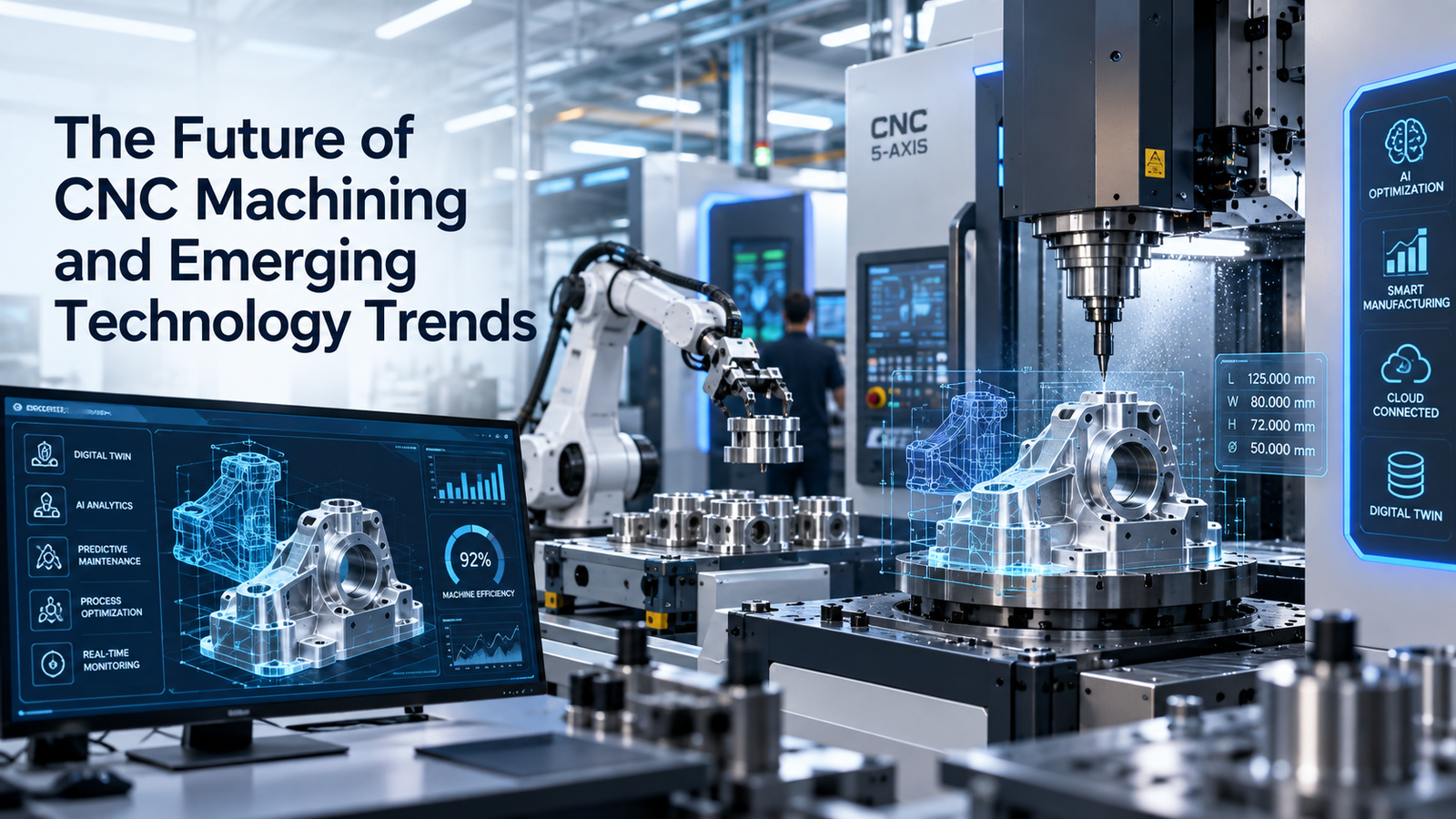
CNC machining is entering a new phase.
Traditional CNC systems already deliver high accuracy, repeatability, and automation, but the next generation is increasingly connected with artificial intelligence, digital twins, robotics, advanced simulation, real-time process monitoring, and data-driven quality systems.
The most important CNC machining trends are not simply about faster machines.
They are about making machining more predictive, adaptive, connected, and easier to optimize before physical production begins.
Manufacturers are under pressure to handle:
- Smaller production batches
- More complex parts
- Shorter delivery times
- Skilled-labor shortages
- Higher quality expectations
- Greater production flexibility
These pressures are accelerating investment in digital machining technologies.
In 2026, Siemens is highlighting machine-specific digital twins, AI-powered CNC programming, connected manufacturing, industrial AI, robotics, and advanced CNC technologies as major directions for modern machine-tool production.
This guide explains the most important CNC machining trends mechanical engineers, manufacturing engineers, programmers, and production managers should watch.
Key Technology Trends
1. Digital Twins Will Become Central to CNC Manufacturing
A digital twin is a virtual representation of a physical machine, process, or production system.
For CNC machining, a machine-specific digital twin can be used to simulate:
- Machine motion
- Toolpaths
- Workholding
- Collisions
- Cycle time
- Machine limits
before production begins.
Siemens describes digital twins as a way to validate and optimize CNC machining processes before the first physical cut.
This can reduce:
- Shop-floor prove-out time
- Collision risk
- Scrap
- Machine downtime
As parts become more complex and batch sizes become smaller, virtual validation becomes increasingly valuable.
2. Virtual CNC Commissioning Will Grow
Virtual commissioning allows engineers to test machining processes in a digital environment before using the real machine.
This can include:
- CNC program validation
- Machine-axis simulation
- Fixture checks
- Tool-clearance checks
- Automation sequence testing
The goal is to identify problems before they reach production.
Digital twins can therefore move troubleshooting from the shop floor into the engineering stage.
3. AI-Assisted CNC Programming Is Emerging
AI is beginning to assist CAM and CNC programming.
Potential applications include:
- Tool selection
- Machining-strategy recommendations
- Parameter suggestions
- Feature recognition
- Toolpath optimization
At IMTS 2026, Siemens is demonstrating AI-powered CNC programming in an end-to-end manufacturing workflow.
The likely future is not fully autonomous programming overnight.
Instead, AI will increasingly work as a programming assistant that helps engineers create and optimize machining processes faster.
4. Industrial AI Will Optimize Machining Parameters
Industrial AI can analyze large amounts of production data.
Possible inputs include:
- Spindle load
- Tool wear
- Vibration
- Cycle time
- Quality measurements
AI models may use this data to identify patterns and recommend better process settings.
Future systems may help optimize:
- Feed
- Speed
- Tool-change timing
- Maintenance timing
This can move machining from fixed process settings toward more data-driven optimization.
5. Adaptive Machining Will Increase
Traditional CNC programs generally follow predetermined parameters.
Adaptive machining adjusts the process based on real operating conditions.
Possible feedback sources include:
- Cutting force
- Spindle load
- Vibration
- Tool wear
The machine can then modify process parameters to maintain stability.
This could help reduce:
- Chatter
- Tool failure
- Excessive load
Adaptive control is especially attractive for variable material conditions and complex parts.
6. CNC Production Will Become More Autonomous
Manufacturing is gradually moving from automated production toward adaptive and increasingly autonomous production.
Autonomous machining may combine:
- AI
- Machine monitoring
- Automated tool management
- Robotic loading
- Automated inspection
The system could respond to changing conditions with less operator intervention.
Siemens' 2026 manufacturing strategy explicitly describes a progression from agile toward more adaptive and autonomous production using digital twins and industrial AI.
7. Robotics Will Become More Closely Integrated With CNC
Robots are already widely used for:
- Machine loading
- Part unloading
- Pallet handling
- Deburring
Future integration will go further.
At IMTS 2026, Siemens is highlighting CNC-controlled robotics designed to combine machine-tool control with robotic flexibility.
Possible applications include:
- Robotic machining
- Large-part trimming
- Flexible loading
- Secondary operations
This can make CNC cells more flexible.
8. Lights-Out Machining Will Expand
Lights-out machining refers to production that continues with minimal direct operator presence.
It may use:
- Pallet systems
- Bar feeders
- Robots
- Tool monitoring
- Automatic inspection
The main challenge is reliability.
A machine that runs unattended must be able to detect:
- Tool wear
- Tool breakage
- Part-loading errors
- Process instability
Advances in sensors and monitoring are making unattended operation more practical.
9. Predictive Maintenance Will Become More Important
Traditional maintenance may be:
- Reactive
- Time based
Predictive maintenance uses machine data to identify developing problems before failure.
Possible monitored signals include:
- Vibration
- Temperature
- Spindle load
- Motor current
- Alarm history
Industrial AI can analyze these signals to identify unusual behavior.
This may help maintenance teams service machines before unexpected downtime occurs.
10. Connected CNC Machines Will Produce More Data
Modern CNC machines generate large amounts of operational data.
Future machine shops will increasingly collect information such as:
- Cycle time
- Machine status
- Tool usage
- Energy consumption
- Alarms
- Quality results
Connected systems can make this data available to:
- Production planning
- Maintenance
- Quality
- Management
The machine tool is becoming part of a wider digital production network.
11. Digital Threads Will Connect Design to Machining
A digital thread connects product data throughout the lifecycle.
In CNC manufacturing, the information flow may include:
- CAD
- CAM
- Simulation
- CNC
- Inspection
- Quality
Instead of repeatedly re-entering data, systems can share information digitally.
This improves traceability and reduces manual translation.
Siemens describes digital threads as the connected information backbone linking engineering, manufacturing, and service.
12. Automated Inspection Will Become More Integrated
Quality inspection is increasingly moving closer to the machining process.
Technologies include:
- In-machine probes
- Automated CMM
- Vision systems
- Laser measurement
Inspection data can potentially feed back into production.
For example, the system may detect dimensional drift and update:
- Tool offsets
- Wear compensation
This creates a more closed-loop manufacturing process.
13. Tool-Wear Monitoring Will Improve
Tool wear affects:
- Accuracy
- Surface finish
- Cycle stability
Future machining systems will increasingly use sensors and data analysis to estimate remaining tool life.
This can help avoid two inefficient extremes:
- Replacing tools too early
- Running tools until failure
Predictive tool management could improve both cost and reliability.
14. Advanced Tooling Will Continue to Evolve
Cutting tools will continue improving through:
- New carbide grades
- Advanced coatings
- Optimized geometries
The objective is to machine:
- Harder materials
- Faster
- With longer tool life
Tooling improvements will remain important even as software and AI become more advanced.
Physical cutting performance still depends on the interaction between:
- Tool
- Material
- Machine
- Process
15. High-Speed Machining Will Become More Intelligent
High-speed machining is not simply about high spindle RPM.
Future systems will increasingly combine high-speed machining with:
- Dynamic toolpaths
- Machine simulation
- Vibration avoidance
- Real-time monitoring
The objective is controlled high productivity rather than aggressive cutting without feedback.
16. Hybrid Manufacturing Will Grow
Hybrid manufacturing combines additive and subtractive processes.
A part may be:
- Additively built near net shape.
- CNC machined to final tolerance.
This is useful for complex components that would be difficult or wasteful to create entirely by machining.
Hybrid manufacturing can support:
- Repair
- Complex internal geometry
- Material efficiency
Siemens' 2026 manufacturing demonstrations connect additive manufacturing with CNC machining as part of a broader digital production workflow.
17. CNC Machining Will Work More Closely With Additive Manufacturing
Additive manufacturing will not replace CNC machining for precision finishing.
Instead, the technologies are increasingly complementary.
Additive can create:
- Complex shapes
- Near-net geometry
CNC machining can provide:
- Precision surfaces
- Tight tolerances
- Threads
- Bearing fits
Engineers will increasingly design processes that use both technologies where each is strongest.
18. Simulation Will Reduce Physical Trial Cuts
Traditionally, new CNC programs may require careful shop-floor prove-out.
More accurate simulation can reduce this dependency.
Digital models can verify:
- Tool motion
- Machine travel
- Fixture clearance
- Collision risk
This saves valuable machine availability for actual production.
Siemens notes that digital twin workflows are increasingly used to move validation from the physical machine into a virtual environment.
19. Cloud-Based Manufacturing Software Will Expand
Manufacturing software is increasingly becoming connected through cloud platforms.
Cloud systems may support:
- Program management
- Collaboration
- Production monitoring
- Analytics
This can help multi-site manufacturers share process knowledge more easily.
Cybersecurity will become increasingly important as more machine data becomes connected.
20. Cybersecurity Will Matter More for CNC Systems
Connected CNC machines create new cybersecurity requirements.
Risks may include:
- Unauthorized program changes
- Network attacks
- Production disruption
Future machine-tool strategies will need to combine manufacturing connectivity with secure access, controlled software updates, and network segmentation.
Connected manufacturing cannot be treated only as an IT issue.
It is also an operational reliability issue.
21. Data-Driven Quality Will Expand
Quality systems are increasingly moving from isolated inspection reports toward connected production data.
Future systems may link:
- Process parameters
- Machine condition
- Tool data
- Inspection results
This could help identify which process conditions lead to quality problems.
Quality management may therefore become increasingly predictive instead of only reactive.
22. Smaller Batch Sizes Will Drive Flexible Automation
Traditional automation often worked best for high-volume production.
Modern manufacturers increasingly need to produce:
- More variants
- Smaller lots
- Customized parts
This is driving demand for flexible automation.
Technologies such as:
- Quick-change fixtures
- Robots
- Digital setup instructions
- Automated tool management
can reduce changeover effort.
23. Human Skills Will Shift Toward Process Optimization
Automation does not remove the need for skilled people.
The required skills are changing.
Future CNC professionals may spend more time on:
- Process optimization
- Simulation
- Data analysis
- Automation
- Robotics
and less time on repetitive manual setup.
Siemens notes that workforce skills shortages are one of the forces pushing machine builders toward connected digital systems and industrial AI.
24. CAM Systems Will Become More Automated
Future CAM software is likely to automate more routine programming tasks.
Examples include:
- Feature recognition
- Toolpath selection
- Tool recommendations
- Cutting-parameter suggestions
This can reduce programming time.
However, experienced programmers will still be needed to evaluate:
- Workholding
- Tool access
- Quality
- Risk
Automation will shift programmer effort toward higher-value decisions.
25. Manufacturing Knowledge Will Become Digital
Experienced machinists often carry valuable process knowledge.
Future systems will increasingly store that knowledge digitally.
Examples include:
- Proven cutting parameters
- Tool-life data
- Successful fixture strategies
- Known machine limitations
AI systems may then use this history to recommend processes for future jobs.
This is especially important as experienced manufacturing workers retire.
Key CNC Machining Trends
| Trend | Expected Impact |
|---|---|
| Digital twins | Virtual machining validation |
| AI-assisted programming | Faster CAM preparation |
| Industrial AI | Data-driven process optimization |
| Adaptive machining | Real-time process adjustment |
| Robotics | Flexible machine tending and machining |
| Lights-out production | Higher machine utilization |
| Predictive maintenance | Reduced unexpected downtime |
| Connected CNC | Better production visibility |
| Digital thread | Connected engineering and production |
| Automated inspection | Faster closed-loop quality |
| Tool monitoring | More predictable tool life |
| Hybrid manufacturing | Additive + subtractive production |
| Cloud manufacturing | Better collaboration |
| Cybersecurity | Greater protection for connected machines |
What Manufacturers Should Prepare For
Companies do not need to implement every new technology immediately.
A practical roadmap may be:
Step 1: Improve Data Collection
Measure:
- Cycle time
- Tool life
- Downtime
Step 2: Improve Simulation
Validate programs before production.
Step 3: Connect Machines
Collect reliable machine data.
Step 4: Add Automation
Automate repetitive loading and handling.
Step 5: Introduce Advanced Analytics
Use data to improve maintenance and machining performance.
Step 6: Expand Toward AI
Apply AI where enough reliable process data exists.
Digital transformation works best when it solves a clear production problem.
Conclusion
The future of CNC machining will be increasingly digital, adaptive, and connected.
The most important CNC machining trends include:
- Digital twins
- AI-assisted CNC programming
- Industrial AI
- Adaptive machining
- Robotics
- Lights-out production
- Predictive maintenance
- Connected machine tools
- Digital threads
- Automated inspection
- Tool monitoring
- Hybrid manufacturing
Current 2026 industry developments show this transition clearly. Siemens is demonstrating machine-specific digital twins, AI-powered CNC programming, connected CNC technologies, robotics, and additive-plus-machining workflows as part of an integrated digital manufacturing strategy. citeturn935198search0turn935198search3
At the same time, the fundamentals of machining remain important.
Future success will still depend on:
- Rigid machines
- Correct tooling
- Stable cutting
- Good workholding
- Accurate programming
The difference is that engineers will have more digital tools to simulate, monitor, predict, and optimize those fundamentals.
The most competitive CNC operations will combine machining knowledge with automation, software, data, and AI rather than treating them as separate technologies.