
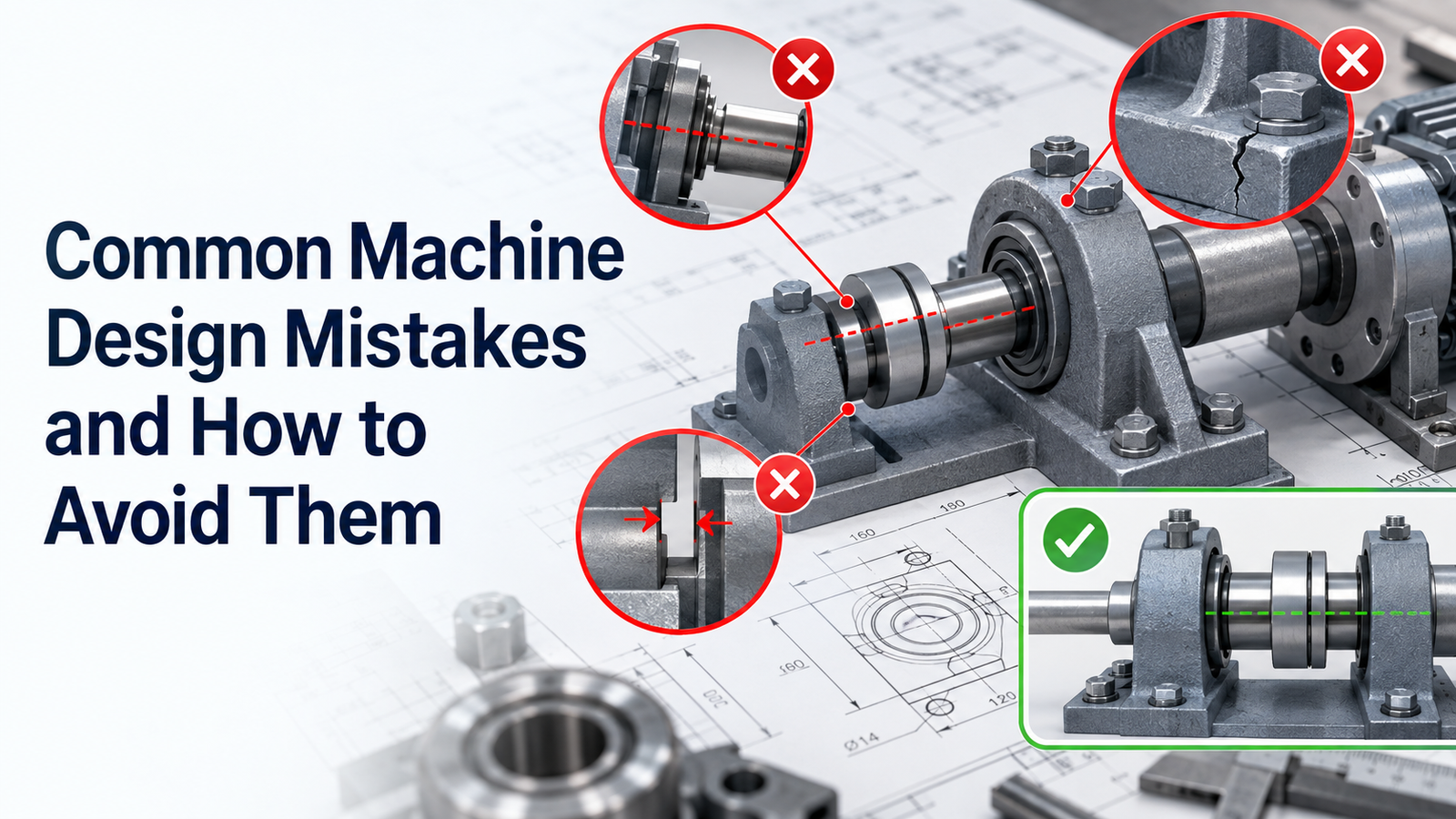
Machine failures are often blamed on components, operators, or maintenance teams, but many recurring problems begin during the design stage.
A bearing may fail because the shaft is misaligned. A motor may overheat because acceleration torque was underestimated. A linear guide may wear early because moment loads were ignored. A machine frame may vibrate because stiffness was not considered. A simple service task may take hours because maintenance access was never planned.
Good machine design fundamentals troubleshooting means identifying these root causes and correcting the design logic that created them.
This guide explains common machine design mistakes, why they happen, and how engineers can avoid them in future projects.
Key Problems and Solutions
1. Mistake: Designing Before Defining Requirements
One of the most common mistakes is starting CAD before the machine requirements are clear.
If load, speed, accuracy, cycle time, and environment are not defined, component selection becomes guesswork.
Before designing, document:
- Product or workpiece size
- Required load
- Travel
- Speed
- Acceleration
- Cycle time
- Accuracy
- Repeatability
- Environment
- Safety requirements
For example, a positioning table designed for 20 kg may fail when the actual fixture and product weigh 45 kg.
How to Avoid It
Create a written requirement specification before detailed design begins.
Convert functional needs into measurable engineering values.
2. Mistake: Using Only Static Load
Many machines fail because only static weight is considered.
Real machines also experience:
- Acceleration
- Deceleration
- Shock
- Vibration
- Moment loads
- Inertia
A carriage weighing 50 kg may create much larger dynamic forces during rapid acceleration.
THK's linear-guide selection process includes speed, acceleration, mounting orientation, center of gravity, applied load, and required life rather than using static mass alone.
How to Avoid It
Calculate dynamic forces for the real motion profile.
Include worst-case acceleration, emergency stops, and overhung loads.
3. Mistake: Selecting Bearings by Shaft Diameter Only
A bearing that fits the shaft is not necessarily suitable for the application.
Bearing selection should consider:
- Radial load
- Axial load
- Speed
- Required life
- Lubrication
- Temperature
- Contamination
- Misalignment
SKF recommends checking both static and dynamic conditions when selecting bearings.
How to Avoid It
Calculate bearing life and static safety.
Also review lubrication, sealing, fit, and operating environment.
4. Mistake: Ignoring Shaft Deflection
A shaft may be strong enough not to break but still bend too much.
Excessive deflection can cause:
- Bearing overload
- Gear misalignment
- Belt tracking problems
- Seal wear
- Vibration
This is a common troubleshooting issue because the bearing may fail first even though the real cause is shaft flexibility.
How to Avoid It
Check both stress and deflection.
Reduce long overhangs and improve bearing support where possible.
5. Mistake: Designing for Strength but Not Stiffness
Strength answers whether a component will fail.
Stiffness answers how much it will deform.
A machine frame can be structurally safe but still flex enough to reduce accuracy.
Poor stiffness can cause:
- Vibration
- Misalignment
- Positioning error
- Fatigue
- Uneven loading
How to Avoid It
Evaluate expected deflection under load.
Increase section stiffness, improve support locations, and reduce unsupported spans.
6. Mistake: Ignoring Moment Loads on Linear Guides
Linear guides do not experience only vertical force.
An offset load can create:
- Pitch moment
- Roll moment
- Yaw moment
Ignoring these moments may result in premature guide wear.
THK provides guidance for calculating applied loads and moments based on mounting orientation and center-of-gravity position.
How to Avoid It
Use the actual payload location.
Check guide block spacing and rail spacing.
7. Mistake: Selecting Motors by Power Alone
Motor power is only part of the requirement.
A motor must also provide:
- Continuous torque
- Peak torque
- Required speed
- Acceleration torque
Load inertia is especially important in dynamic machines.
How to Avoid It
Calculate the full torque-speed profile.
Include transmission efficiency, acceleration, and duty cycle.
8. Mistake: Ignoring Thermal Expansion
Temperature changes can alter dimensions.
Thermal expansion may affect:
- Long shafts
- Precision frames
- Ball screws
- Guide alignment
- Sensor position
A machine that performs correctly when cold may shift after reaching operating temperature.
How to Avoid It
Identify major heat sources.
Allow controlled thermal growth where necessary and avoid over-constraining long assemblies.
9. Mistake: Using Tight Tolerances Everywhere
Very tight tolerances increase manufacturing cost and can make assembly difficult.
Not every dimension requires precision.
How to Avoid It
Apply tight tolerances only to functional features such as:
- Bearing fits
- Alignment surfaces
- Locating diameters
- Guide mounting faces
Use general tolerances for noncritical dimensions.
10. Mistake: Poor Datum Strategy
Without clear reference surfaces, assembly becomes inconsistent.
Problems include:
- Misaligned rails
- Incorrect hole positions
- Difficult inspection
- Cumulative dimensional error
How to Avoid It
Define clear datums.
Use machined reference surfaces, shoulders, and locating pins where repeatable assembly is important.
11. Mistake: Poor Lubrication Planning
A component may be selected correctly but fail because lubrication cannot be performed easily.
Common problems include:
- Hidden grease fittings
- No service clearance
- Wrong lubricant
- Long intervals
THK emphasizes that lubrication is critical for reducing friction, wear, and contamination-related damage in linear guides.
How to Avoid It
Make lubrication points accessible.
Use centralized or automatic lubrication where justified.
12. Mistake: Ignoring Contamination
Dust, chips, coolant, and water can dramatically reduce component life.
Affected components may include:
- Bearings
- Linear guides
- Ball screws
- Seals
How to Avoid It
Use:
- Covers
- Wipers
- Bellows
- Seals
- Scrapers
Select protection based on the real environment.
13. Mistake: Poor Fastener Design
Loose fasteners can cause serious failures.
Problems may come from:
- Insufficient preload
- Wrong bolt grade
- Poor joint stiffness
- Vibration
- Short thread engagement
How to Avoid It
Select fasteners properly and follow suitable tightening methods.
Use locking methods where required.
14. Mistake: No Maintenance Access
Some machines are difficult to service because components are blocked by covers, frames, or other assemblies.
A simple bearing replacement may require extensive disassembly.
How to Avoid It
During CAD review, check access for:
- Tools
- Fasteners
- Bearings
- Motors
- Sensors
- Lubrication
Design service zones into the machine.
15. Mistake: No Replacement Clearance
A component may fit during assembly but be impossible to remove later.
How to Avoid It
Check removal paths for:
- Motors
- Gearboxes
- Bearings
- Belts
- Couplings
Maintenance should be considered during layout design.
16. Mistake: Oversizing Everything
Oversizing may seem safe, but it creates problems.
Larger components increase:
- Cost
- Weight
- Inertia
- Motor size
- Frame load
One oversized component can cause the entire machine to become larger and more expensive.
How to Avoid It
Use appropriate engineering safety factors instead of extreme oversizing.
17. Mistake: No Design Review
Many errors survive because nobody reviews the full machine before manufacturing.
How to Avoid It
Perform a structured design review.
Include:
- Mechanical engineering
- Electrical engineering
- Automation
- Manufacturing
- Maintenance
Check loads, access, safety, interfaces, and assembly.
18. Mistake: Testing Only After Full Assembly
Waiting until the complete machine is built makes problems expensive to fix.
How to Avoid It
Prototype uncertain mechanisms.
Test critical motions, gripping, feeding, and alignment early.
19. Mistake: Running Full Speed Immediately
New machines should not be commissioned at maximum speed from the first cycle.
How to Avoid It
Use staged commissioning:
- Manual movement
- Low-speed operation
- Sensor verification
- Load testing
- Automatic operation
- Full-speed validation
This makes faults easier to isolate.
20. Mistake: Fixing the Symptom Instead of the Root Cause
Repeated component replacement is not troubleshooting.
For example:
Repeated bearing failure
Possible root causes:
- Misalignment
- Wrong fit
- Poor lubrication
- Shaft deflection
- Contamination
- Overload
Replacing the bearing without correcting the cause only delays the next failure.
How to Avoid It
Use root-cause analysis.
Ask why the failure occurred and what design condition created it.
Practical Machine Design Troubleshooting Checklist
| Problem | Likely Design Cause |
|---|---|
| Bearing fails repeatedly | Misalignment or overload |
| Motor overheats | Wrong torque sizing |
| Guide wears early | Moment load or contamination |
| Machine vibrates | Low stiffness or imbalance |
| Belt tracks poorly | Misalignment |
| Bolts loosen | Poor joint design |
| Accuracy changes | Thermal growth or deflection |
| Maintenance takes too long | Poor service access |
| Components fail during acceleration | Dynamic load ignored |
| Frequent redesign | Weak requirement definition |
Conclusion
Many machine problems begin before the machine is built.
Effective machine design fundamentals troubleshooting means examining the design assumptions behind the failure rather than only replacing damaged parts.
Load, acceleration, stiffness, alignment, lubrication, contamination, tolerances, thermal behavior, maintenance access, and design review all influence reliability.
The best way to reduce troubleshooting is to design with failure prevention in mind.
By defining requirements clearly, calculating real loads, checking deflection, planning maintenance, and reviewing the design before manufacturing, engineers can reduce downtime, improve reliability, and avoid expensive redesign.