
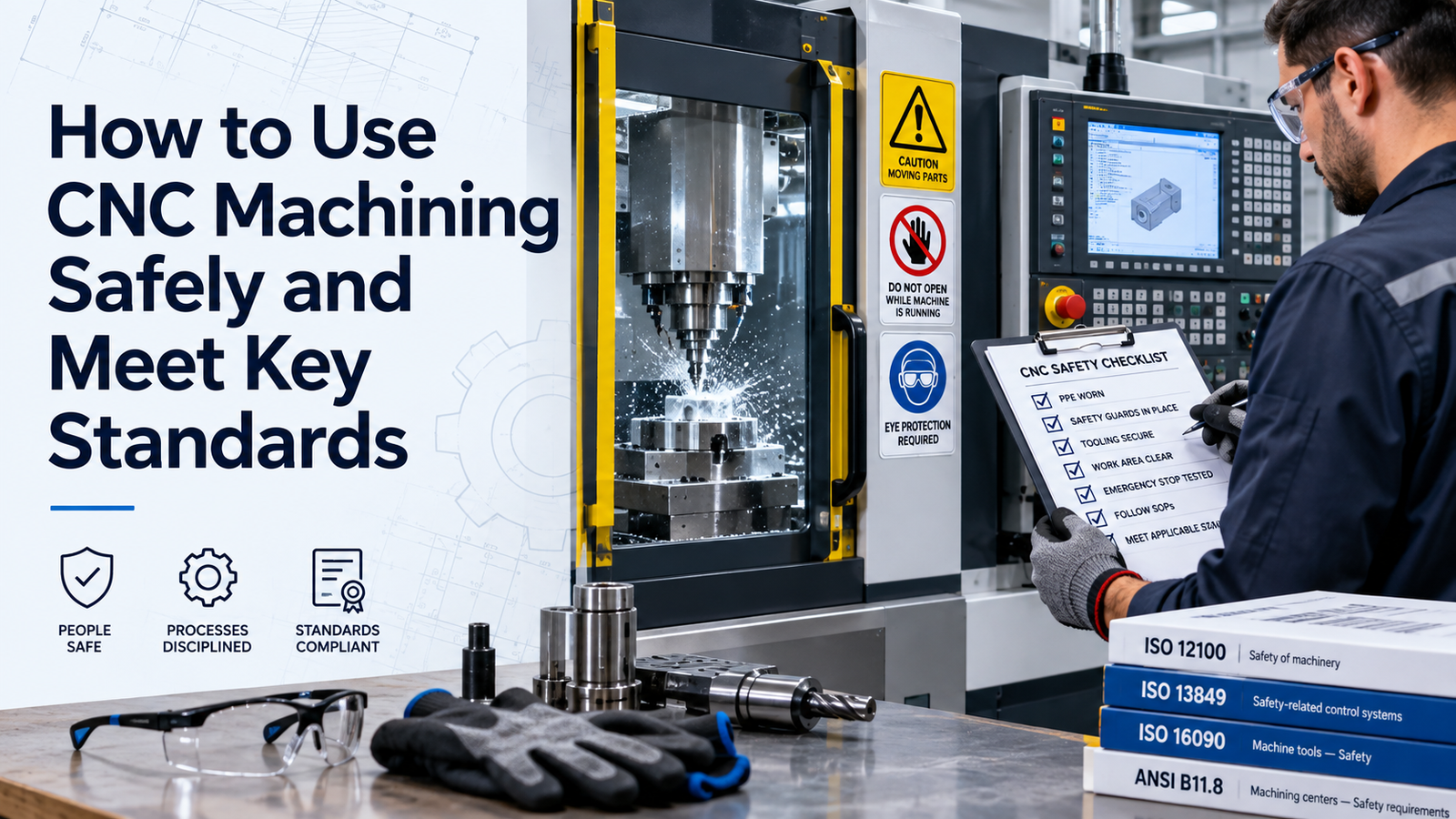
CNC machines are designed to cut material quickly, accurately, and repeatedly. The same power that makes them productive also creates serious hazards if guarding, workholding, tooling, operating procedures, or maintenance controls are inadequate.
Good CNC machining safety requires more than personal protective equipment.
A safe machining system combines:
- Risk assessment
- Machine guarding
- Interlocks
- Emergency stops
- Secure workholding
- Correct tooling
- Safe operating procedures
- Lockout/tagout
- Operator training
- Preventive maintenance
International and national standards provide a structured framework for controlling these risks. ISO 16090-1:2022 remains the current published international standard for machining centres, milling machines, and transfer machines, although a future revision is already under development. ISO 23125:2015 remains current for turning machines and turning centres, while a replacement draft is also under development.
This guide explains practical CNC safety measures and the key standards engineers, operators, and manufacturing managers should understand.
Key Safety Practices and Standards
1. Understand the Main CNC Machining Hazards
CNC machining hazards can come from:
- Rotating spindles
- Cutting tools
- Moving axes
- Flying chips
- Broken tools
- Ejected workpieces
- Coolant
- Electrical systems
- Stored hydraulic or pneumatic energy
- Automatic tool changers
- Chip conveyors
A machine enclosure reduces many hazards during automatic operation, but setup, inspection, maintenance, and troubleshooting can place operators closer to dangerous motion.
Safety procedures must therefore cover the complete machine lifecycle.
2. Keep Machine Guards and Enclosures in Place
Machine guards protect operators from:
- Rotating parts
- Flying chips
- Broken tools
- Sparks
- Moving components
OSHA 29 CFR 1910.212 requires guarding to protect operators and employees from hazards including point-of-operation hazards, rotating parts, flying chips, and sparks.
Never remove or bypass a guard simply to save cycle time.
If a guard interferes with production, the engineering solution should improve the guarding system rather than eliminate protection.
3. Do Not Defeat Door Interlocks
Modern CNC machines commonly use door interlocks to restrict automatic machine motion when doors are open.
Interlocks should never be:
- Bypassed
- Taped closed
- Mechanically defeated
- Disabled in software without an approved engineering procedure
An interlock is part of the machine's protective system.
If setup or maintenance requires movement with a door open, use only manufacturer-approved operating modes and restricted procedures.
4. Verify Emergency Stops
Emergency-stop devices provide a way to stop hazardous machine motion quickly in an emergency.
Operators should know:
- Where emergency stops are located
- What equipment they stop
- How the machine must be reset afterward
Emergency-stop systems should be checked according to the machine manufacturer's maintenance requirements.
Emergency stops are not a replacement for guarding or safe operating procedures.
5. Use Lockout/Tagout for Servicing and Maintenance
A machine that appears stopped may still contain hazardous energy.
Sources can include:
- Electrical energy
- Hydraulic pressure
- Pneumatic pressure
- Gravity
- Stored mechanical energy
OSHA's lockout/tagout requirements call for an energy-control program, employee training, and periodic inspections so machines are isolated and rendered inoperative before servicing and maintenance where hazardous energy could cause injury.
Typical LOTO steps include:
- Identify energy sources.
- Shut down the equipment.
- Isolate energy.
- Apply locks and tags.
- Release stored energy.
- Verify isolation.
- Perform the work.
- Restore equipment using the approved procedure.
Never rely only on pressing the CNC stop button.
6. Secure the Workpiece Correctly
An improperly clamped workpiece can become a projectile.
Before machining, verify:
- Correct jaw engagement
- Fixture condition
- Clamping pressure
- Workpiece support
- Part location
For turning operations, confirm the workpiece is held securely in the chuck or collet.
Long parts may require:
- Tailstock support
- Steady rest
- Additional workholding
Workholding should be designed for the cutting forces generated by the process.
7. Check Tooling Before Running the Program
Inspect:
- Cutting tool condition
- Toolholder
- Insert seating
- Collet
- Pull stud
- Tool length
Damaged or incorrectly installed tooling can fail at high rotational speed.
Check that the tool:
- Matches the programmed tool number
- Has the correct offset
- Is rated for the operating speed
For high-speed applications, toolholder balance and rotational limits become especially important.
8. Verify Chuck and Fixture Limits
Do not exceed:
- Chuck speed rating
- Fixture limits
- Toolholder speed rating
- Manufacturer load limits
Centrifugal force increases rapidly with rotational speed.
A workholding device that is safe at one speed may not be safe at a much higher speed.
9. Perform a Safe Program Prove-Out
New CNC programs should be proven out carefully.
Possible safeguards include:
- Simulation
- Single-block mode
- Reduced rapid override
- Dry run where appropriate
- Safe-distance verification
Check:
- Tool path
- Work offsets
- Tool length
- Clearance
- Fixture position
Program verification is particularly important after:
- Fixture changes
- Tool changes
- Postprocessor changes
- Program revisions
10. Keep Clear of Automatic Tool Changers
Automatic tool changers can move quickly.
Do not place hands or tools inside the changer area unless the machine is in an approved safe maintenance state.
Possible hazards include:
- Crushing
- Pinching
- Unexpected movement
- Falling tools
Follow the manufacturer's maintenance procedure for tool changer service.
11. Control Flying Chips Safely
Metal chips can be:
- Sharp
- Hot
- Long
- Difficult to handle
Never remove chips with bare hands.
Use suitable tools such as:
- Chip hooks
- Brushes
- Pliers
- Approved chip-handling equipment
Do not reach into the work area while the machine is running.
Eye and face protection may also be necessary when personnel are exposed to flying particles.
12. Manage Coolant Safely
Metalworking fluids can create:
- Skin irritation
- Slip hazards
- Mist exposure
- Contamination issues
Good practices include:
- Maintaining correct coolant concentration
- Controlling leaks
- Using mist extraction where required
- Keeping floors clean
- Following the coolant supplier's safety information
Operators should avoid prolonged skin contact with contaminated coolant.
13. Use Appropriate PPE
PPE requirements depend on the specific operation and workplace risk assessment.
Common items can include:
- Safety glasses
- Safety footwear
- Hearing protection
OSHA requires suitable eye and face protection when workers are exposed to flying-particle hazards.
However, PPE is the last layer of protection after engineering and administrative controls.
Do not use gloves around exposed rotating machinery where they could become entangled.
14. Control Loose Clothing and Hair
Rotating machinery can catch:
- Loose sleeves
- Jewelry
- Long hair
- Lanyards
Before operating or setting up CNC equipment:
- Secure long hair
- Remove loose jewelry
- Avoid loose clothing
Entanglement risk is especially important around turning machines and exposed rotating components.
15. Never Leave Setup Tools in the Machine
Remove:
- Chuck keys
- Wrenches
- Setup blocks
- Measuring tools
- Loose fasteners
before starting the spindle or cycle.
A forgotten tool can become a projectile.
Use a formal pre-start check for complex setups.
16. Be Careful With Compressed Air
Compressed air is commonly used in machining areas for chip removal.
However, uncontrolled air can send chips toward:
- Operators
- Other workers
- Electrical cabinets
- Machine mechanisms
Use chip-removal methods that comply with workplace rules and local safety requirements.
Machine-contained air blast or vacuum systems may be safer for many applications.
17. Prevent Fire Risks
CNC machining can create heat, sparks, hot chips, and combustible mist depending on the material and process.
Pay special attention when machining materials that can create increased fire or combustion risk.
Keep:
- Machine interiors clean
- Chip buildup controlled
- Coolant systems maintained
Fire protection should be selected based on the actual material and machining process.
Operators should know the site's emergency response procedure.
18. Keep the Work Area Clean
Housekeeping affects safety.
Coolant leaks and chips can create:
- Slip hazards
- Cuts
- Blocked access
Keep:
- Floors dry
- Walkways clear
- Emergency stops accessible
- Electrical panels accessible
A clean machine area also makes leaks and equipment problems easier to identify.
19. Train Operators for the Specific Machine
General CNC experience is not enough for every machine.
Operators should understand:
- Machine controls
- Emergency stops
- Interlocks
- Setup procedures
- Workholding
- Tool changing
- Alarm response
Training should match the specific equipment and job responsibilities.
Only authorized people should perform tasks requiring specialized access or maintenance.
20. Use Risk Assessment for Non-Routine Work
Normal automatic machining may be well guarded.
Higher risk can occur during:
- Setup
- Adjustment
- Troubleshooting
- Cleaning
- Maintenance
- Recovery from alarms
These tasks should be reviewed separately.
Ask:
- Can unexpected movement occur?
- Is stored energy present?
- Does guarding need to be opened?
- Is LOTO required?
Non-routine work should not rely on improvised practices.
21. Follow ISO 16090-1 for Machining Centres and Milling Machines
ISO 16090-1:2022 specifies technical safety requirements and protective measures for:
- Milling machines
- Machining centres
- Transfer machines
It covers the design, construction, supply, installation, dismantling, transport, and maintenance context for these machine categories.
As of 2026, ISO 16090-1:2022 remains the current published edition, although ISO is developing Edition 3 to replace it.
For companies specifying or purchasing CNC machining centres, the standard is an important reference for machinery safety requirements.
22. Follow ISO 23125 for Turning Machines
ISO 23125:2015 covers safety requirements and risk-reduction measures for turning machines and turning centres, including numerically controlled machines.
The standard was confirmed in 2024 and remains current.
ISO is developing a replacement, ISO/DIS 23125-1.2, but that document is still a draft and should not be treated as the current published standard.
This distinction matters for compliance documentation and machine specifications.
23. Understand OSHA Machine Guarding Requirements
For workplaces subject to U.S. OSHA requirements, 29 CFR 1910.212 establishes general machine-guarding requirements.
It addresses protection from hazards such as:
- Point of operation
- Rotating parts
- Flying chips
- Sparks
OSHA also requires fixed-location machinery to be securely anchored.
Even outside the United States, the underlying principles are useful for understanding practical machinery guarding expectations.
24. Include Safety in Preventive Maintenance
Safety devices require maintenance too.
Inspect according to the manufacturer's requirements:
- Door switches
- Guards
- Emergency stops
- Enclosures
- Brakes
- Hydraulic systems
- Pneumatic systems
Do not focus preventive maintenance only on machining accuracy.
A machine that produces accurate parts but has unreliable safety devices is not in acceptable condition.
25. Report Safety Device Failures Immediately
If an interlock, guard, or emergency stop does not function correctly:
- Stop using the affected equipment where necessary.
- Report the issue.
- Follow the site's isolation and repair procedure.
Do not create a temporary bypass to keep production running.
Production pressure should never override critical machine-safety controls.
CNC Machining Safety Checklist
| Area | Key Safety Check |
|---|---|
| Guarding | Doors and enclosures intact |
| Interlocks | Never bypassed |
| Emergency stop | Accessible and maintained |
| Workholding | Part securely clamped |
| Tooling | Correct and undamaged |
| Program | Proved out safely |
| Chips | Removed with tools, not hands |
| Coolant | Leaks and exposure controlled |
| PPE | Appropriate to identified hazards |
| Maintenance | LOTO used when required |
| Housekeeping | Chips and coolant controlled |
| Training | Operator authorized and competent |
Common CNC Safety Mistakes
Avoid these mistakes:
- Bypassing door interlocks
- Running with damaged guarding
- Reaching into a moving machine
- Leaving chuck keys or tools in the work area
- Removing chips by hand
- Using incorrect or damaged workholding
- Ignoring toolholder speed limits
- Performing maintenance without energy isolation
- Using gloves near exposed rotating machinery
- Continuing operation with defective safety devices
Most CNC incidents are easier to prevent than to recover from.
Conclusion
Good CNC machining safety requires engineering controls, disciplined procedures, trained operators, and effective maintenance.
Core practices include:
- Keep guarding and interlocks functional.
- Secure tools and workpieces correctly.
- Prove out new programs carefully.
- Control chip and coolant hazards.
- Use appropriate PPE.
- Apply lockout/tagout during hazardous maintenance.
- Maintain emergency stops and protective devices.
- Train operators for their specific machines.
For standards, ISO 16090-1:2022 remains the current published international safety standard for machining centres, milling machines, and transfer machines, while ISO 23125:2015 remains current for turning machines and turning centres. Both areas have future revisions under development, so engineers should distinguish published requirements from draft replacements.
For U.S. workplaces, OSHA 29 CFR 1910.212 provides general machine-guarding requirements, and OSHA 1910.147 addresses control of hazardous energy during servicing and maintenance.
Safety should never be treated as separate from productivity.
A well-guarded, well-maintained CNC process with clear setup and maintenance procedures is more predictable, easier to operate, and less likely to suffer costly incidents or unplanned downtime.